ParaView 6.1.0 Release Notes

ParaView 6.1.0 has been released. For a comprehensive list of new features in ParaView 6.1.0, please see the ParaView 6.1.0 release notes hosted on ParaView’s GitLab project page.
This release has some notable additions highlighted in this post.
ANARI rendering integration in ParaView
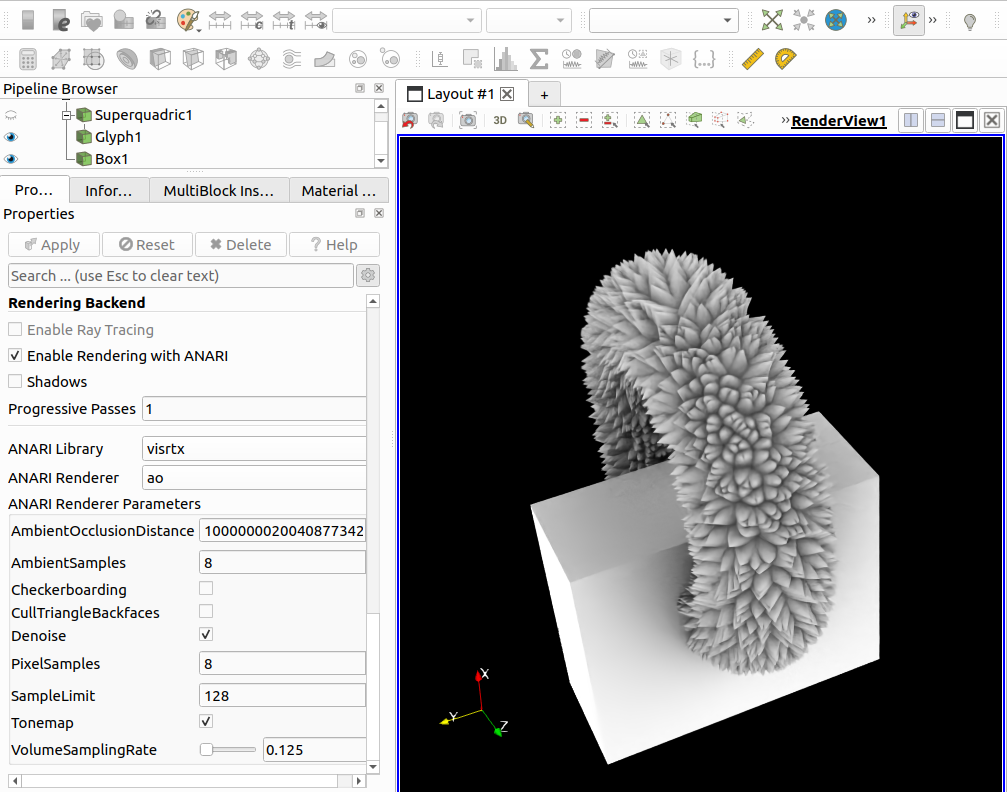
Rendering through ANARI is available in ParaView 6.1.0 built from source. The current integration uses a simple approach to delegate ray-traced rendering to ANARI. The Properties panel presents you with a choice between the original Enable Ray Tracing (with OSPRay) and Enable Rendering with ANARI. Please note: ANARI is not yet available in ParaView binaries posted to paraview.org, but ParaView can be built against ANARI libraries. More information…
USD scene exporter
A USD scene exporter is now available in ParaView, accessible through the File -> Export Scene menu item. It exports surface polygonal geometry including point normals if available, cell normals otherwise, color mapped surfaces through export of color map textures and texture coordinates on surfaces, directional lights, the current camera, including position and direction, actor transforms, solid colored surfaces, including their color and physically-based rendering (PBR) properties supported by the USD format when PBR is enabled, and all surfaces from composite datasets. More information…
Improved plotting of Partitioned Dataset Collections in chart representations
For Partitioned Dataset Collections and Multi-block Datasets, chart representations can now summarize all selected blocks (as made visible in the MultiBlock Inspector) as a single chart entity such as a line or box plot rather than generating a separate entity for each block. This behavior is controlled by the new Array Selection Mode property, which can be set to “Merged Blocks” (new default) or “Individual Blocks” (previous behavior). More information…
Statistical analysis refactor
To work around several shortcomings of the existing statistics filters in VTK and ParaView, we have refactored the filters. The new capabilities are not identical to the old; in some ways there is less functionality because rare use cases are not supported, but in many ways the functionality is more useful. More information…
Selections are saved and loaded from state files
Selections are now saved and loaded from both .pvsm and Python state files. This includes all types of selections (ID, frustum, blocks, and so on).