Protect Patient Privacy and Securely Share Digital Pathology Data
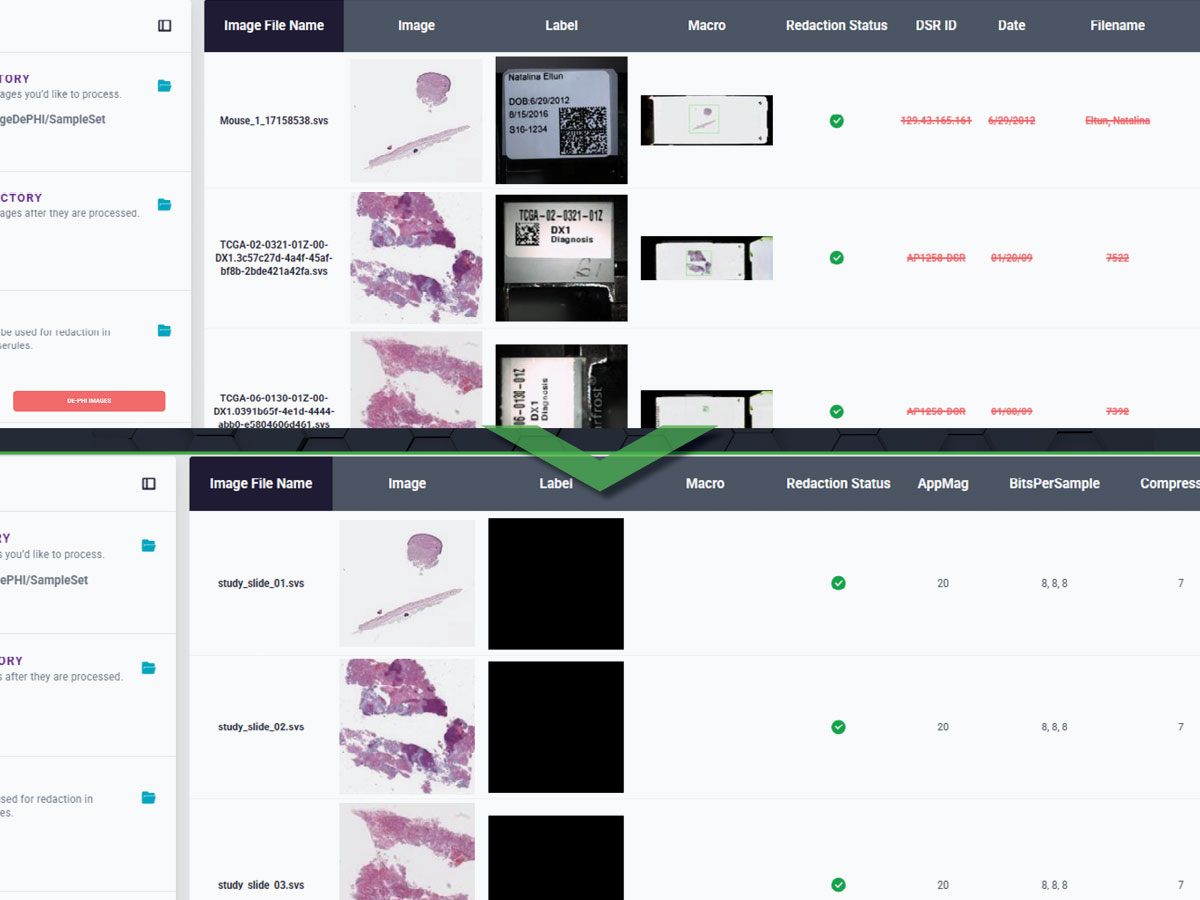
Sharing digital pathology data is essential for advancing research and AI-driven projects, but protecting patient privacy can be a challenge when handling massive datasets. PHI (Protected Health Information) and PII (Personally Identifiable Information) can exist in unexpected places within whole slide images (WSIs), from embedded text on labels to metadata fields and scanner comments. Without proper anonymization, sensitive details can limit collaboration, delay publication, and increase compliance risk.
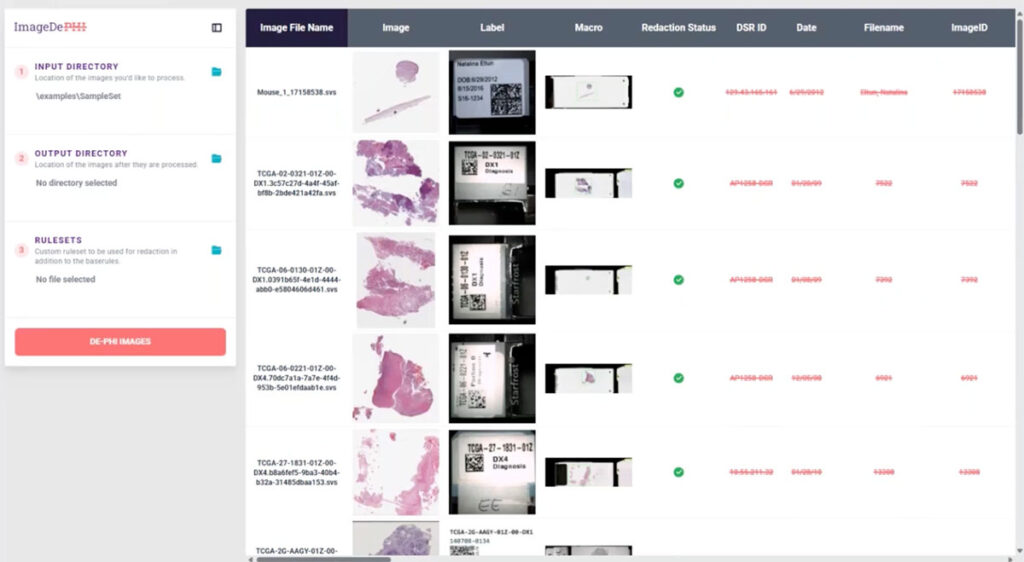
What Is ImageDePHI?
ImageDePHI is Kitware’s framework for automating the anonymization of digital pathology data. It helps organizations remove PHI while maintaining traceability and data integrity, streamlining compliance and secure data sharing.
Using ImageDePHI, researchers can identify hidden sensitive information in WSIs, validate that their data is truly PHI-free, and integrate scalable automated workflows across large datasets.
For data managers and pathologists, ImageDePHI provides a reliable way to protect patient privacy while enabling collaboration, publications, and AI/ML model development without unnecessary manual effort.
The Value of Automated De-Identification
ImageDePHI transforms data anonymization into an efficient, repeatable workflow. Key benefits include:
- Detecting PHI hidden in labels, metadata, and scanner comments.
- Automating de-identification to scale across large WSI datasets.
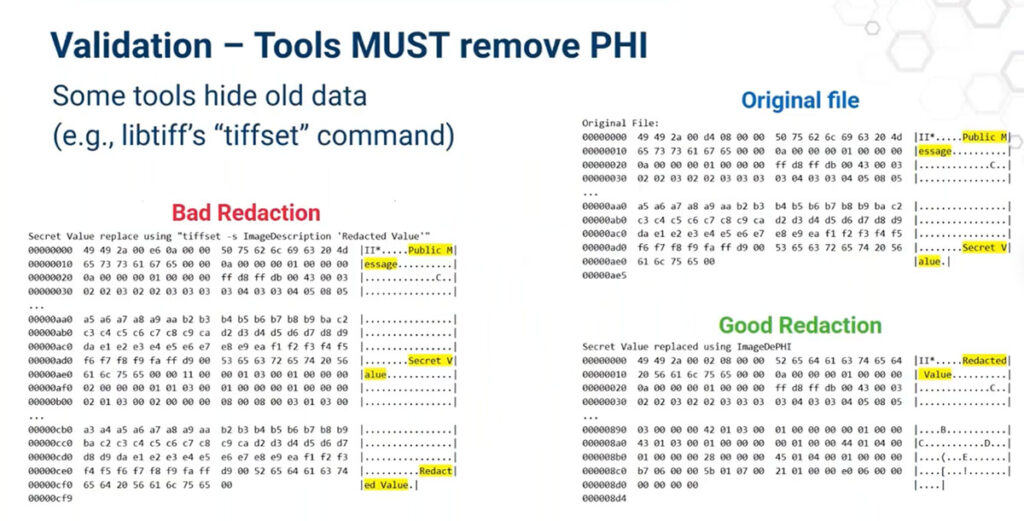
- Validating that images are PHI-free to ensure compliance.
- Developing adaptable anonymization policies for multiple projects.
- Accelerating collaboration, publication readiness, and AI/ML development.
- Preserving data integrity while removing sensitive information.
Leverage ImageDePHI with Kitware
In our on-demand webinar, Kitware experts David Manthey and Aashish Chaudhary demonstrate how to identify and remove sensitive information from WSI data while maintaining traceability. In the replay, you’ll learn:
- Where PHI commonly hides in digital pathology images.
- Practical strategies for de-identification at scale.
- Validation techniques to ensure PHI-free data.
- How to create adaptable anonymization policies for different projects.
- Ways to accelerate collaboration and prepare datasets for publication or AI/ML workflows.
ImageDePHI combines automation, transparency, and format flexibility, making anonymization faster, more reliable, and easier to integrate into existing pipelines.
Real-World Applications
Multi-Site Research Studies
ImageDePHI enables secure sharing of pathology datasets across institutions, ensuring PHI is removed without compromising data quality.
AI/ML Model Development
Researchers can use de-identified WSIs to train AI models without privacy concerns, while maintaining traceability and workflow reproducibility.
Publication & Collaboration
Automated anonymization allows researchers to meet regulatory requirements, prepare data for journals, and collaborate efficiently with external teams.
By embedding ImageDePHI into digital pathology workflows, organizations can protect patient privacy, accelerate research, and streamline data sharing, all without the burden of manual anonymization.
Expert Guidance for Secure Digital Pathology Workflows
At Kitware, we combine deep technical expertise with experience in AI, digital pathology, and open source software. Our team helps research and clinical teams implement automated, compliant, and scalable anonymization workflows. Contact us for advanced support or customized solutions to protect sensitive data and accelerate your projects.