Kitware Collaborates on PhySIC to Advance Full-Body Physiological Modeling
Kitware is part of an Applied Research Associates (ARA)-led team, alongside Aeris, AV, and Netrias, developing the Physiological Systems Integration and Computation (PhySIC) platform for the Defense Threat Reduction Agency/Joint Science and Technology Office (DTRA/JSTO).
Now in its second year, PhySIC is being developed to transform human-relevant data into full-body physiological simulations. The platform bridges microphysiological systems (MPS) data, AI-driven harmonization, and multi-scale hybrid modeling to produce insights into health effects, exposure outcomes, and medical countermeasure performance.
Kitware’s involvement in PhySIC builds on our expertise in computational physiological modeling and medical simulation. Our experience includes developing open-source technologies that simulate the body’s response to trauma, disease, and treatment, particularly through our development, maintenance, and advancement of the Pulse Physiology Engine.
Connecting Human-Relevant Data With Physiological Models
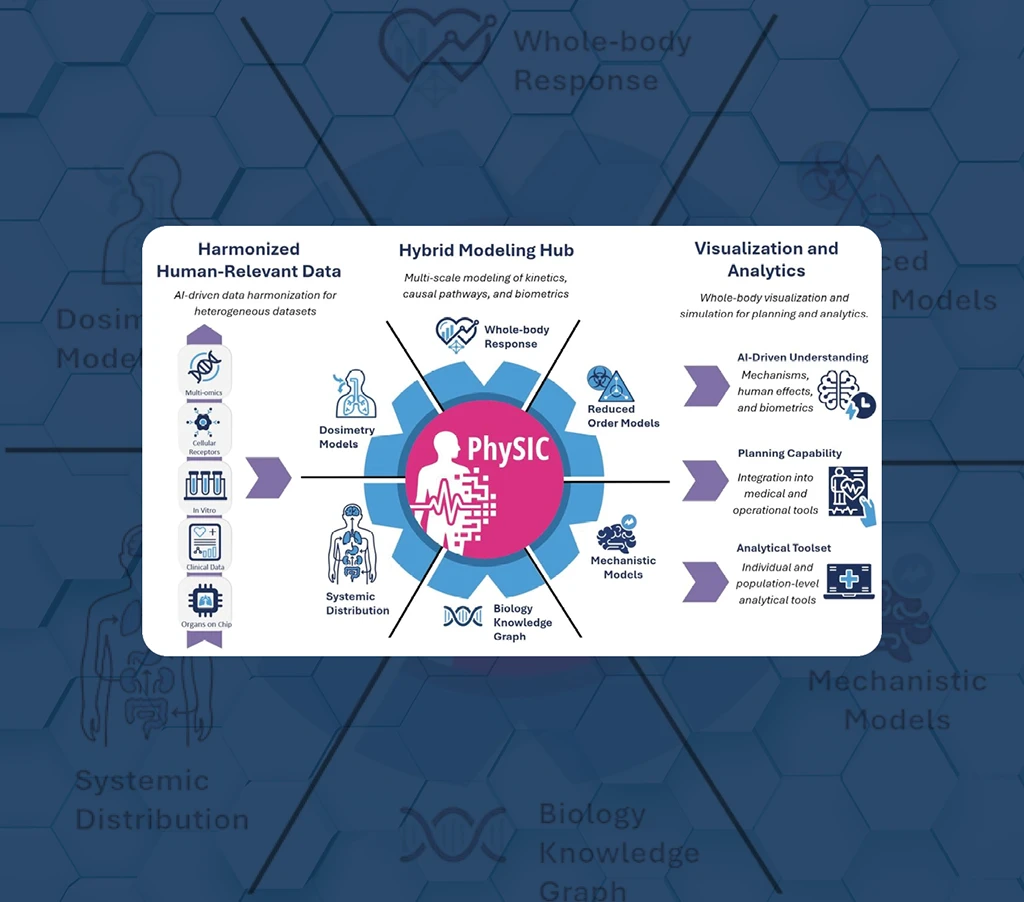
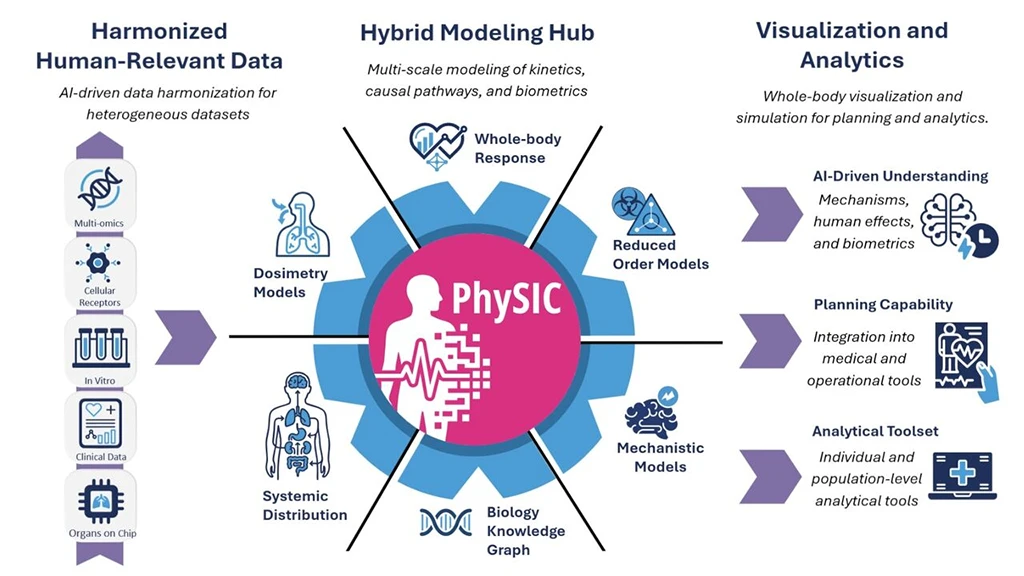
PhySIC uses AI-driven data harmonization to integrate human-relevant data, including multiomics, cellular receptors, in vitro data, clinical data, and organs-on-chip.
The platform’s hybrid modeling hub brings together dosimetry models, systemic distribution, a biology knowledge graph, mechanistic models, reduced-order models, and whole-body response. Whole-body visualization and simulation support planning and analytics.
Supporting Medical and Operational Planning
PhySIC aims to accelerate decision-making through rapid and defensible predictions of human effects from chemical and biological (CB) exposures and medical countermeasures.
The platform supports scenario exploration, in silico trials, individualized physiology, and population effects. These capabilities are intended to provide estimates of injury and disease severity, performance degradation, countermeasure efficacy, and biometric signals.
Interested in learning more about Kitware’s work in computational physiological modeling and medical simulation? Contact our team to discuss how we can support your research and development needs.