Medical Image AI Researchers Need a Secure Annotation Platform
Medical imaging AI research often runs into a familiar bottleneck: the data exists, but security requirements make it unusable. Sensitive datasets are:
- Locked behind compliance constraints.
- External experts can’t be granted access safely.
- Hard to ingest and analyze with off-the-shelf SaaS platforms.
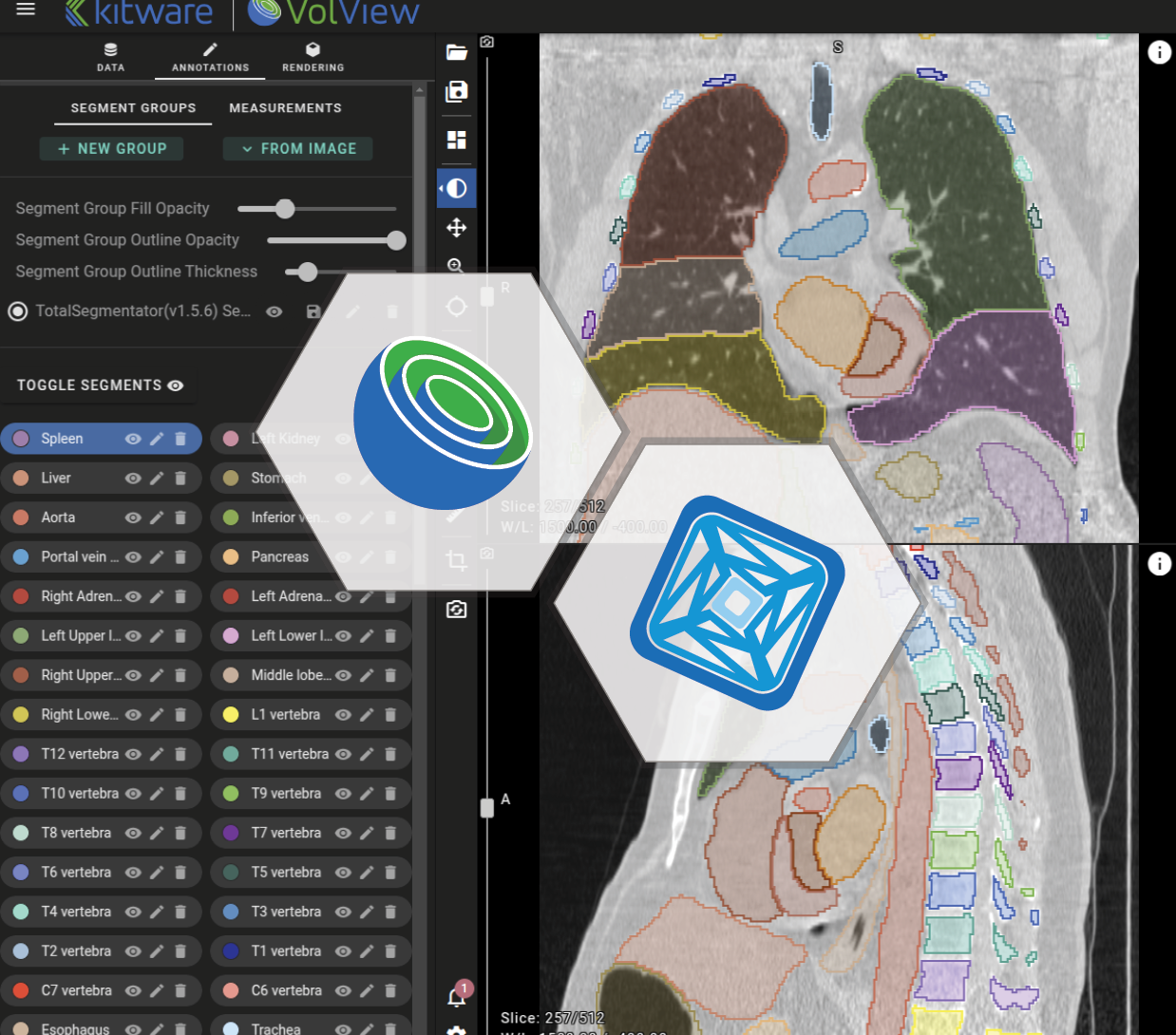
Over the past three years, Kitware has worked closely on a self-hosted medical image annotation deployment designed to address this challenge. The result is a secure platform that keeps sensitive data fully within a company’s in-house cloud. Built on VolView and Girder, the open source platform supports custom medical image AI workflows.
Collaborative Workflows with Sensitive Datasets
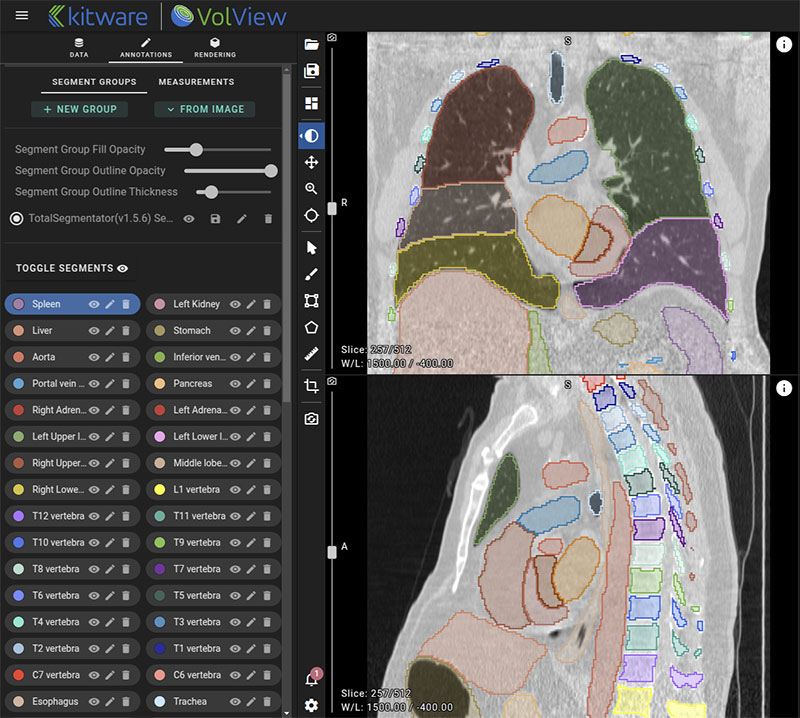
The deployment supports medical image research scientists, software engineers, and annotation operations specialists who contract with radiologists for annotations.
Diverse Datasets and Annotation Types
The deployment supports multiple simultaneous projects:
- Musculoskeletal imaging: Hand joint detection using bounding box annotations on X-ray images.
- Oncology imaging: Lung cancer tracking using PET and CT scans, with DICOM SEG based segmentation for longitudinal tumor monitoring.
While the technical expertise was in place, progress was limited by infrastructure constraints.
Why Existing Approaches Fell Short
- Strict data security and compliance requirements: Medical imaging data needed to remain inside a secure environment to meet HIPAA, GDPR, and internal governance standards.
- Heterogeneous imaging formats: Datasets stored in cloud storage included X-ray, PET, and CT data across formats such as DICOM, DICOM SEG, NRRD, and NIFTI.
- External annotator access: Contract radiologists required browser-based annotation tools, but granting access without exposing sensitive data was challenging.
- Limited flexibility of SaaS platforms: Prior experience with SaaS medical imaging platforms highlighted the need for greater control over deployment, customization, and integration with internal systems.
Extending Existing Infrastructure with VolView and Girder
Rather than introducing an entirely new system, the platform extends existing Girder-based infrastructure already used for digital pathology workflows.
When radiological imaging support became necessary, VolView provided a natural extension, adding web-based radiological viewing and annotation capabilities while preserving established data management, security, and automation practices.
A Secure, Self-Hosted Annotation Platform
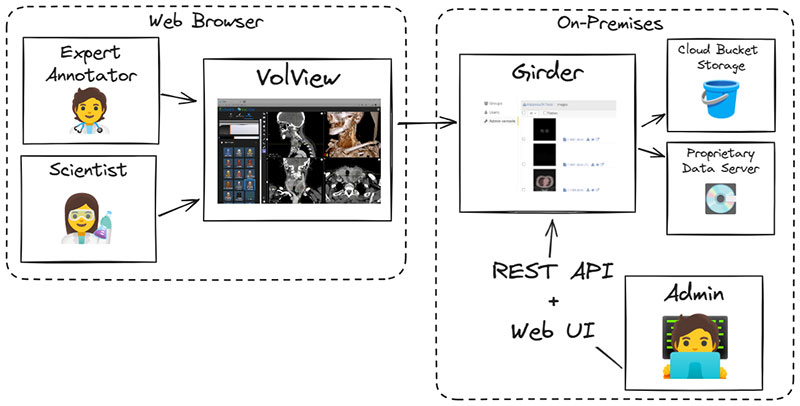
As discussed in our earlier work on self-hosted annotation platforms for medical image AI researchers, deploying annotation workflows within an organization’s own infrastructure is often the only viable way to balance data security, regulatory compliance, and collaboration with external experts. Here, the solution extended existing Girder-based infrastructure by integrating VolView to enable secure, self-hosted radiological annotation workflows.
Key Capabilities
- Self-hosted deployment: All medical imaging data remains inside the controlled environment, enabling projects previously blocked by security constraints.
- Indexes Cloud Storage Buckets: Girder unifies access to imaging datasets across modalities and formats stored in S3.
- Secure collaboration with external experts: Contract radiologists access VolView through a web browser, with fine-grained permissions controlling dataset access.
- Open source flexibility: The platform can be customized and extended as research needs evolve, without vendor lock-in.
How the Platform Works in Practice
Infrastructure Foundation
The deployment builds on the Digital Slide Archive (DSA) with Girder. Used for digital pathology workflows, data ingestion, user management, REST APIs, and job execution for preprocessing and analysis.
VolView integrates directly with this foundation to support radiological imaging workflows.
Annotation Workflow
- Imaging datasets are indexed from S3 using Girder.
- Annotation tasks are configured and datasets are permissioned for specific users.
- Contract radiologists access VolView through a web browser and perform expert annotations using radiology-focused tools.
- Annotation sessions can be saved and resumed, with completed results stored for downstream model training and evaluation.
This workflow enables efficient collaboration without compromising data security.
Platform Development
Over the past three years, Kitware has contributed enhancements to both VolView and its integration with Girder to meet evolving requirements.
girder_volview Enhancements
- Session save and restore for long-running annotation tasks.
- Configurable layouts and annotation labels via .volview_config.yaml.
- Customizable keyboard shortcuts for efficient expert annotation.
- Automatic layer and segment group association based on filename patterns.
- S3 proxy support for flexible bucket configurations.
- Python Session Builder API for programmatic session creation from analysis pipelines.
VolView Core Improvements
- Multi-image viewing for comparison and longitudinal analysis
- Configurable grid layouts with axial, coronal, sagittal, and 3D views.
- Bounding box annotation tools for musculoskeletal imaging.
- DICOM SEG support for oncology segmentation workflows.
- Polygon annotation tools.
- Remote save functionality for seamless Girder integration.
These capabilities are now broadly available to the VolView community.
Unblocking Medical Image AI Research
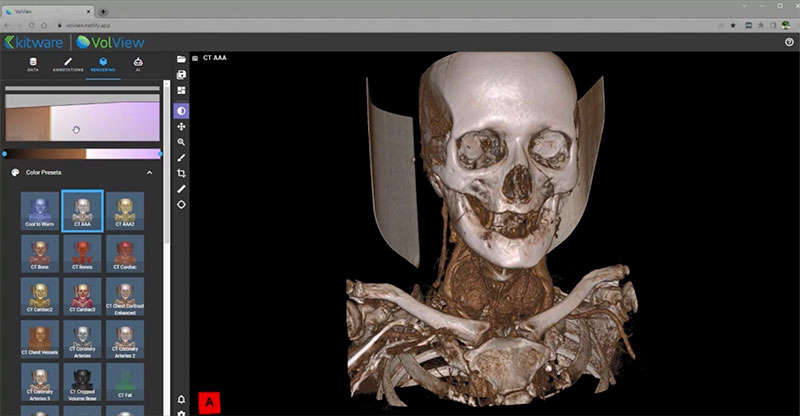
The most important outcome was straightforward but impactful: secure access to sensitive medical imaging data unlocked AI projects that were previously infeasible.
With the VolView + Girder platform in place, the deployment now supports:
- Diagnostic algorithm development under strict data governance requirements.
- Unified workflows across X-ray, PET, and CT imaging.
- Secure collaboration with external radiologists.
- Custom preprocessing and analysis pipelines integrated with annotation workflows
Secure Open Source Solutions for Medical AI
Across healthcare and pharmaceutical research, a familiar challenge keeps emerging: highly valuable data remains underutilized due to strict security, privacy, and compliance requirements.
Self-hosted, open source annotation and visualization platforms offer a practical way forward, combining strong data governance with the flexibility needed for advanced AI research and secure external collaboration.
For organizations facing similar data privacy and compliance challenges, VolView and Girder provide a proven, extensible foundation for secure medical imaging and AI workflows, without compromising control of sensitive data.
Contact Kitware to learn how we can help you unlock the full value of your data while meeting your privacy and security requirements.
Resources:
- VolView: https://volview.kitware.com/
- Digital Slide Archive: https://github.com/DigitalSlideArchive
- girder_volview plugin: https://github.com/DigitalSlideArchive/girder_volview
- Related blog post: https://www.kitware.com/self-hosted-annotation-platform-for-medical-image-ai-researchers/