- Webinar
- October 14, 2026
- 12-1pm ET
Advancing Civil Engineering Simulation with CMB: Water Flow and Hydraulic Structures
Explore CMB’s latest OpenFOAM-based capabilities for simulating water flow around and through hydraulic structures.


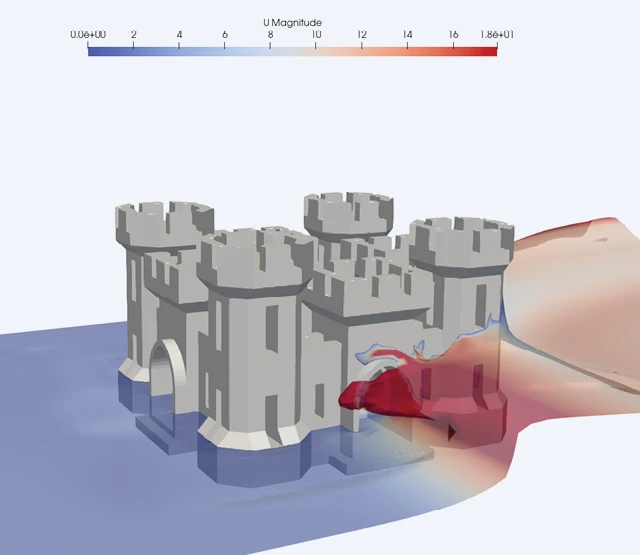
Building on the previous Wind Tunnel Modeling with CMB and Making Waves with Computational Model Builder webinars, this session will showcase the latest advances in CMB’s simulation-modeling capabilities using OpenFOAM. The webinar will focus on civil engineering workflows for analyzing water flow around and through hydraulic structures such as spillways, culverts, channels, gates, and related infrastructure.
During the 45-minute presentation, we will demonstrate an end-to-end workflow, from preparing geometry and defining the computational domain to creating a mesh, assigning water-flow conditions, and generating the appropriate OpenFOAM input decks. Attendees will also see how simulation results, including velocity, pressure, water movement, and free-surface behavior, can be visualized and evaluated.
Special attention will be given to functionality added since the earlier webinars and how these improvements make complex simulation workflows easier to configure, manage, and reproduce. These capabilities include enhanced management of long-duration tasks, access to an expanded suite of OpenFOAM utilities, additional boundary and initial conditions, refined simulation parameter controls, and advanced tools for post-processing visualization.
We will also explain how to access and install the software and provide resources for getting started.
CMB and its supporting technologies are open source and available under a permissive BSD license. This allows organizations to freely use, modify, extend, and integrate the software into both research and commercial engineering workflows.
The presentation will be followed by an additional 10-minute question-and-answer session.
Key Takeaways
Attendees will learn:
- What capabilities have been added since the previous CMB webinars.
- How CMB supports civil engineering workflows involving hydraulic structures.
- How to prepare geometry and computational domains for water-flow analysis.
- How to define water properties, initial conditions, and boundary conditions.
- How to generate and execute an OpenFOAM-compatible simulation.
- How to visualize and interpret water-flow results.
- How to access, install, and begin using the software.
- How the permissive BSD license supports customization and commercial adoption.
Who Should Attend
- Civil engineers working with water-flow simulations.
- Technical teams working with hydraulic structures such as spillways, culverts, channels, gates, and related infrastructure.
- Organizations interested in using, modifying, extending, or integrating open source simulation software into research or commercial engineering workflows.
- Scientists and engineers who use OpenFOAM and are interested in tailored workflow tools for their application areas.