- Webinar
- August 18, 2026
- 12-1pm ET
kwneuro: An Open Source Structural and Diffusion Neuroimaging Toolkit
Simplify structural and diffusion MRI analysis with a lightweight, Python-based toolkit that brings commonly used methods into one cohesive ecosystem.


Structural and diffusion MRI researchers often need to connect multiple specialized toolkits, each with its own formats, conventions, APIs, and system-level dependencies. Building and maintaining these environments can create barriers to analysis, particularly when moving between local workstations, institutional HPC clusters, and cloud-computing environments.
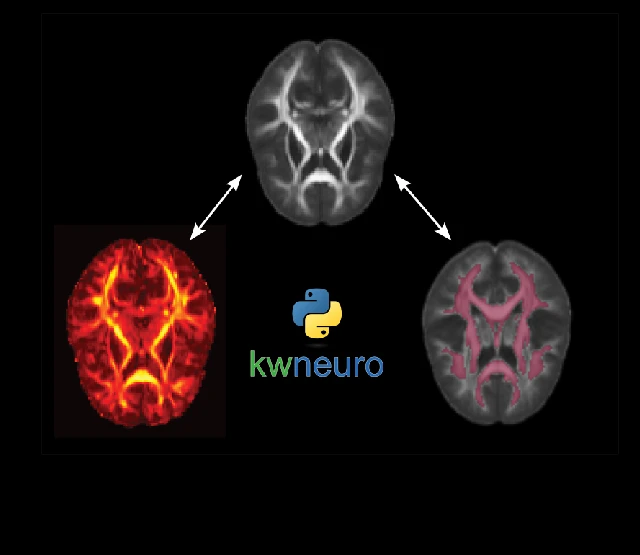
kwneuro is an open source, Python-based toolkit designed to bring commonly used structural and diffusion MRI methods into a cohesive ecosystem. It provides a lightweight option for researchers who want to perform standard analyses with minimal friction.
During this webinar, Kitware’s experts will:
- Introduce kwneuro and walk through its core structural and diffusion neuroimaging capabilities.
- Demonstrate how to install and use the toolkit in a Python environment and in 3D Slicer.
- Present a clinical or scientific use case showing how kwneuro can support real-world analysis.
- Explain how developers and researchers can expand the toolkit, incorporate additional methods, and contribute to its development.
A live Q&A session will follow the presentation.
Key Takeaways
- Understand the core capabilities of the kwneuro toolkit.
- Learn how to create a Python-based neuroimaging research and development environment from scratch.
- See how kwneuro can be used in Python and 3D Slicer.
- Learn how to extend the toolkit or contribute back to the open source project
Who Should Attend
Whether you’re conducting research that requires structural or diffusion neuroimage processing, developing new neuroimaging workflows, or looking for a simpler way to perform standard analyses, this webinar will show how a lightweight, Python-based toolkit can help.
This webinar is ideal for:
- Neuroimaging researchers, including postdoctoral researchers, research scientists, PhD students, and principal investigators.
- Clinical researchers working with large-scale diffusion MRI datasets.
- Developers and engineers building Python-based neuroimaging workflows.
- Researchers who are comfortable with Python and basic diffusion MRI concepts but are not necessarily experts in the underlying toolkits.