- Webinar
- November 4, 2026
- 12-1pm ET
Network Digital Twins with NetMaestro for Wide-Area Network Simulation
Explore how NetMaestro can help network engineers and researchers test capacity, congestion, and configuration changes without experimenting on a production network.
Speakers

Network engineers and researchers at research and education networks and national labs regularly face what-if questions about their networks. They may need to understand how a link failure, routing change, or different buffer configuration could affect throughput and fairness. Testing these scenarios on a production network risks disrupting the science it serves, while physical testbeds are scarce and small. Packet-level network simulators can also be too slow for larger-scale networks and often require deep simulation expertise and hand-written configuration.
These questions are becoming increasingly relevant as data volumes from experimental facilities grow and place more traffic on ESnet and other research and education networks. AI training and inference workflows are changing traffic patterns further, making it harder to rely on past experience to predict how a change will play out..
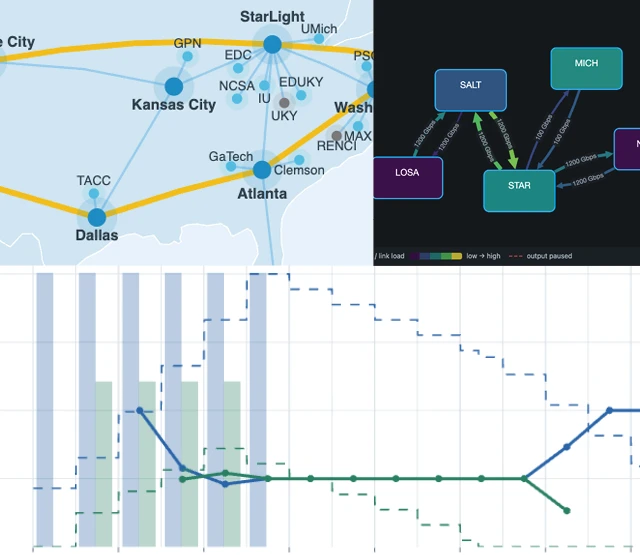
The webinar will introduce how NetMaestro works and include a demonstration of a WAN study built around a realistic what-if question.
Key Takeaways
- Understand what NetMaestro’s WAN model captures.
- Learn how NetMaestro works through a realistic wide-area network what-if study.
- Understand when simulation can answer a wide-area what-if question and when it cannot.
- Learn how the models are being validated against real network testbeds and what the current results show.
Who Should Attend
- Network engineers, architects, performance/measurement engineers, and testbed operators.
- Research scientists and research software engineers involved in computer network research.
- Managers and decision-makers, particularly at smaller regional networks.
- Networking and data movement groups at DOE labs and research testbed communities.
- HPC hardware vendors interested in the simulators’ HPC network models.