How to Stress-Test Your AI Models Without Collecting New Data
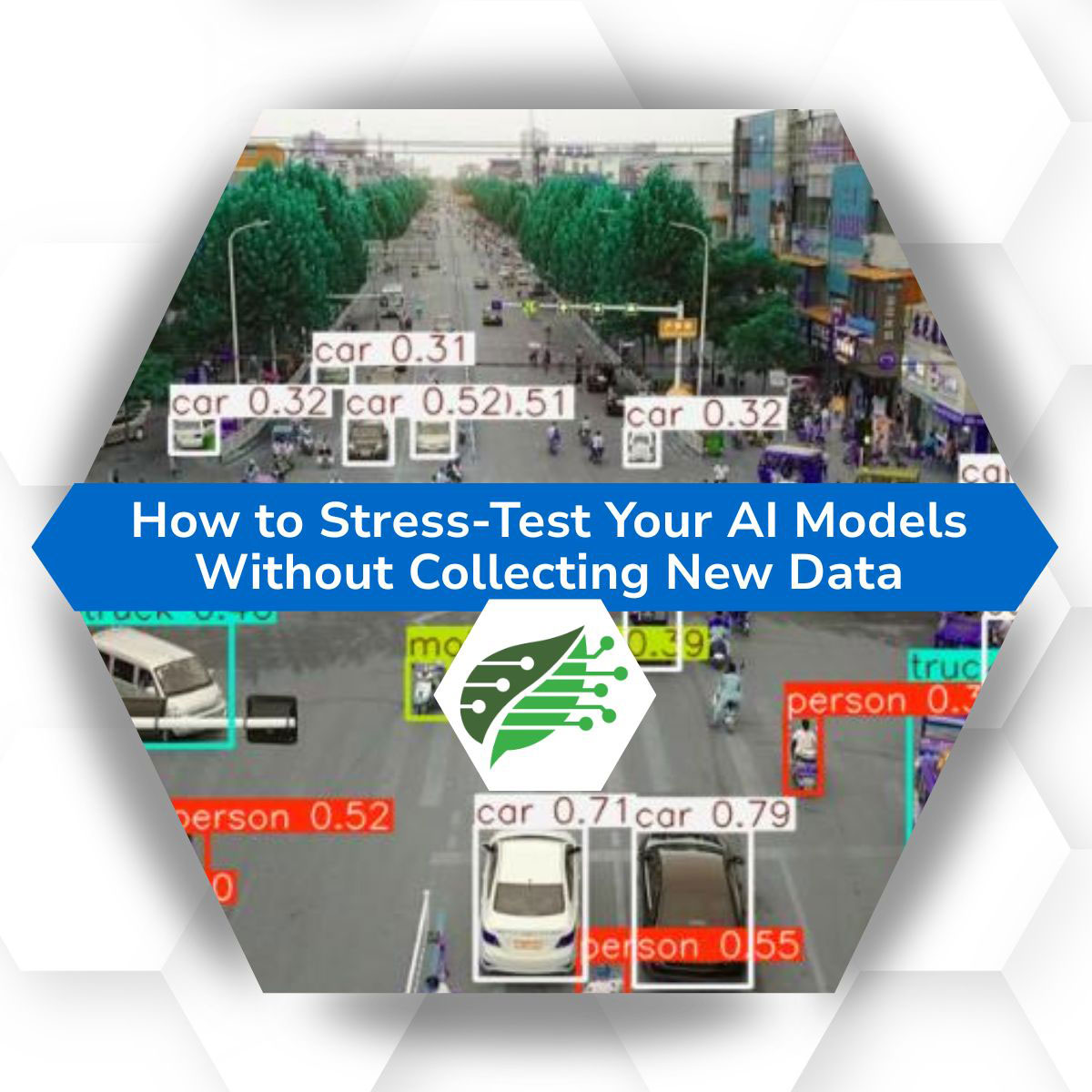
AI models don’t usually fail in the lab. They fail when they leave it. A model that performs well on curated datasets can quickly break down when faced with real-world conditions. Subtle shifts in lighting, weather, sensor quality, or environmental noise can all impact performance. The issue is not always the model itself. It is that testing rarely reflects the conditions the model will actually encounter.
Collecting real-world edge cases might seem like the obvious fix, but in practice, it is expensive, slow, and often impossible to scale. So the question becomes: how do you test for the real world without constantly collecting new data? One answer is to rethink what “testing” looks like.
Simulating Real-World Conditions
Rather than chasing every possible edge case, a more scalable approach is to simulate them.
By applying controlled, parameterized perturbations to existing datasets, you can recreate the kinds of conditions that cause models to fail. These include blur, haze, noise, and lighting shifts. Instead of waiting for those scenarios to appear in real data, you generate them intentionally.
From Static Testing to Performance Under Stress: This shifts testing from a binary question of whether a model works to a deeper understanding of how performance changes as conditions degrade and where it begins to break down.
These perturbations allow engineers to generate controlled data sweeps, identify boundaries of reliable model performance, and visualize degradation under specific operational conditions, all without the prohibitive cost of collecting new field data.
From Perturbations to Measurable Robustness
This is where the Natural Robustness Toolkit (NRTK) comes in.
NRTK is an open source framework designed to expand existing datasets with realistic perturbations and make robustness testing repeatable. It operates across different stages of the imaging pipeline, before, during, and after data capture, allowing teams to evaluate model behavior under a wide range of conditions.
What Makes These Perturbations Different
Traditional data augmentation often lacks real-world relevance. NRTK focuses on perturbations that reflect operational conditions, including environmental effects like fog and atmospheric turbulence, as well as sensor-related issues such as noise, resolution limits, and lens distortion.
The toolkit includes dozens of built-in perturbations and many more through interoperable interfaces, all configurable through precise parameters.
Moving Beyond a Single Accuracy Metric
Instead of producing a single accuracy metric, this approach creates a performance profile under stress. You can observe how accuracy shifts as conditions worsen, making it possible to identify failure points in a structured way.
A Repeatable Workflow for Evaluation
What makes this approach especially valuable is that it is reproducible.
A Typical Workflow
- Loading a model and dataset.
- Applying perturbations.
- Running inference across parameter ranges.
- Analyzing performance trends.
This approach focuses testing on exposing specific failure points, helping identify where development improvements or real data collection should be prioritized. Instead of relying on isolated tests or intuition, teams can build a repeatable process to understand how models behave under stress and where they break down.
Why This Matters
For teams deploying AI systems in complex or variable environments, this approach fills a critical gap.
Earlier Insight, Lower Cost
It reduces reliance on costly data collection by exposing weaknesses earlier in the development process. It can also help focus real-world data efforts where they matter most, rather than replacing them entirely.
Scalable Evaluation
It also creates a shared framework for evaluation that can scale across teams and use cases, giving organizations a more consistent way to assess model performance.
See the Workflow in Practice
If you want to see how this works in practice, including setup, configuration, and example perturbation testing, watch the full walkthrough from Kitware’s engineers:
The session covers installing and validating NRTK, applying perturbations to sample imagery, and designing parameter sweeps to evaluate model performance under stress.
Rethinking What It Means to Test AI
Most models do not fail because they were inaccurate during testing. They fail because testing did not reflect reality.
By shifting from static evaluation to controlled, scenario-driven testing, teams can uncover failure modes earlier and build systems that are better prepared for real-world conditions without starting from scratch every time new challenges arise.
Connect with the Team Behind NRTK
If you are looking to incorporate robustness testing into your AI workflows or want to explore how NRTK can support your specific use case, the Kitware team is here to help.
Our engineers actively develop and apply these tools across real-world projects in government, industry, and research. Whether you are evaluating deployed systems or building new models, we can help you design a testing strategy that reflects the conditions your AI will actually face.
Connect with Kitware to start the conversation.