Partner with Kitware to Accelerate Medical Software Product Development
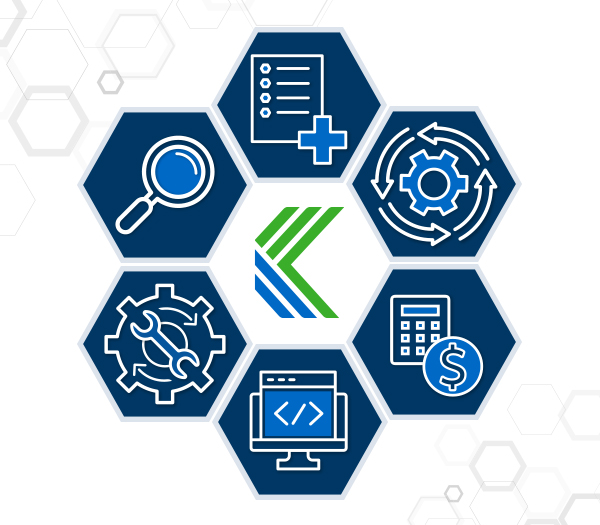
Developing medical software is complex. From early-stage concepts to production-ready systems, organizations must navigate technical challenges, clinical requirements, and regulatory considerations, all while moving quickly and managing risk.
Kitware partners with medical device companies, digital health innovators, and research organizations to accelerate the development of advanced medical software products. By combining deep domain expertise with open source platforms and advanced visualization technologies, we help teams move efficiently from concept to deployable solutions.
For more than 20 years, Kitware has helped organizations transform ideas into impactful medical software across areas such as medical imaging, surgical planning, and clinical workflows. Today, we extend that expertise to support modern systems that increasingly incorporate AI-driven capabilities alongside traditional software approaches.
Turning Innovation into Action
Kitware has deep expertise in the software as a medical device (SaMD) industry, building desktop, mobile, HPC, and web application products for image-guided intervention and surgical planning, computational physiological modeling, image analysis algorithms, ultrasound systems, cross-platform interactive applications, dental and craniofacial analysis, point-of-care ultrasound, and virtual surgical simulation. Where appropriate, we incorporate AI-assisted approaches, such as detection, segmentation, and decision support, to enhance these systems while aligning with existing clinical workflows. Leveraging CMake, we efficiently develop and deploy cross-platform applications across diverse environments and devices.
We understand that medical device companies simply cannot afford to invest significant resources (hiring staff, allocating long-term funding, etc.) to develop proofs of concept (POCs) and prototypes, ensure regulatory compliance, and conduct feasibility studies for a large number of product ideas. At the same time, smaller companies often need to scale their operations quickly to move promising concepts forward. This is where our teams can come into play, augmenting internal efforts both in terms of the number of engineers and the depth of expertise required to advance development efficiently. Partnering with Kitware provides the opportunity to develop state-of-the-art technology in a fraction of the time and at a fraction of the cost.
For over 20 years, Kitware has demonstrated its ability to successfully work with manufacturers and technology companies to bring their prototypes to market. Our customer highlights are a testament to this proven track record of collaboration with companies such as Xstrahl, RAPID, and Exconicus.
The Kitware Difference
Kitware provides a unique combination of expertise, technology, and collaboration to support medical software development from early prototypes through production-ready systems.
The right people: Our teams include experienced software developers, world-class imaging scientists, and AI researchers who understand both the technical and clinical aspects of medical software development.
The right infrastructure: We build on powerful open source platforms such as VTK, ITK, CMake, ParaView, VolView, and 3D Slicer, technologies widely used for visualization, image analysis, and scientific computing. These platforms enable rapid prototyping, scalability, and long-term sustainability.
The right development approach: We help organizations quickly develop and evaluate proofs of concept and prototypes, allowing teams to test ideas, gather feedback, and make informed decisions early.
Practical AI integration: Rather than treating AI as a standalone component, we integrate AI-assisted methods into complete software systems, ensuring solutions are usable, interpretable, and aligned with real clinical workflows. We also evaluate whether AI is the most appropriate approach for the task at hand, drawing on our expertise in both modern AI and traditional machine learning methods to understand and balance the tradeoffs of each.
A collaborative business model: Our open source driven approach allows us to work closely with your team to design and develop tailored solutions while maintaining flexibility and transparency.
A cost-effective strategy: We enable organizations to explore new ideas efficiently, reducing upfront investment while accelerating development and decision-making.
How We Work
Kitware follows a collaborative and structured process designed to accelerate development while reducing risk.
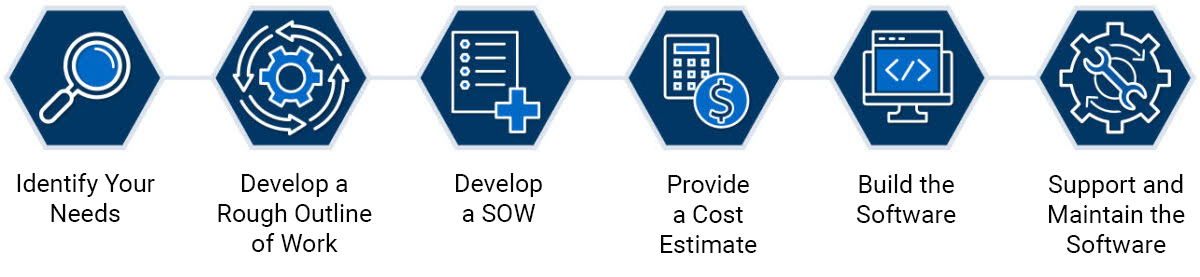

Step 1. Identify Your Needs
We will work with you to answer the following questions:
- What do you want the system to do?
- What is the current standard of care?
- How will the software solution fit into the clinical environment?
- Where does the data come from? Where does the output go?
- Are there opportunities to incorporate AI-assisted capabilities (e.g., detection, segmentation, decision support)?

Step 2. Develop a Rough Outline of Work
After collecting responses, we identify the intended users, the intended use of the product, and the environmental constraints where the product will be deployed, including technological and regulatory considerations. In other words, we work with you to translate your needs and wishlists into actionable requirements and implementation details.
Step 3. Develop a SOW
We capture the outcomes from Steps 1 and 2 in a statement of work (SOW). This document serves as a system requirements specification, including both functional requirements (what the system must do to satisfy user needs) and non-functional requirements (such as target platform, safety, data privacy, security, and, when applicable, AI/ML considerations, including data strategy and model performance expectations).

Step 4. Provide a Cost Estimate
With the assistance of our Finance and Contracts teams, we develop a cost estimate for a time and materials (T&M) contract, a flexible contracting vehicle well-suited for these engagements. Drawing on our extensive experience building customized solutions, we provide estimates that are both reasonable and reliable.

Step 5. Build the Software
After executing the contract, we follow agile development frameworks to develop the software. We hold regular meetings to review progress, iterate on concepts, and refine priorities throughout the project. This close collaboration ensures transparency and has consistently led to strong, long-term partnerships.

Step 6. Support and Maintain the Software
We continue to support, maintain, and enhance the solution over time, providing updates, customizations, and ongoing improvements to AI-enabled components to ensure performance, usability, and compliance.
Supporting Modern Medical Software Development
As medical software systems evolve, so do the requirements for bringing them to market.
Support for FDA application submissions
Over the past few years, Kitware has garnered experience working on custom products that require FDA approval. Kitware can closely collaborate with your regulatory compliance partner(s) to provide support throughout the regulatory process. We can generate system requirements specifications as well as software architecture design documents. We can also help develop software suites for application verification and validation.
HIPAA compliance
Kitware now has the ability to sign a Business Associate Agreement (BAA) to assist our customers on projects that may require access to patient health information (PHI). We have HIPAA compliance processes, procedures, and tools deployed to conduct research that requires access to PHI.
Integrating AI into Clinical Workflows
We help embed AI and data-driven methods into real-world systems, ensuring outputs are meaningful, reliable, and actionable within clinical workflows.
Make Kitware Part of Your Plans
As you embark on your new year and explore partners for your product development, consider how Kitware can help you bring impactful and innovative medical device technology to market. Request a meeting to speak with our medical computing experts today.
Contact Us3D Slicer Maintenance & Support
For teams leveraging 3D Slicer, Kitware offers dedicated maintenance and support packages to help ensure your workflows remain stable, supported, and efficient. We provide timely issue resolution, regular access to Kitware experts, and scalable support options tailored to your organization’s needs.
View 3D Slicer support options