Kitware at the DARPA Triage Challenge Finals Expo: Advancing AI-Assisted Medical Triage
Kitware is attending the DARPA Triage Challenge Finals Expo to showcase how our expertise in artificial intelligence (AI), computer vision, and physiological simulation is helping address challenges in military medical care.
Through our research and open source technologies, we’re helping advance military medical care and readiness. At the Expo, we’ll demonstrate how our work addresses challenges in casualty documentation and trauma training while highlighting ongoing research in AI-assisted medical decision-making.
Supporting Battlefield Medics with AI
DEMO: RAPID-TC3 – Automated Casualty Care Documentation
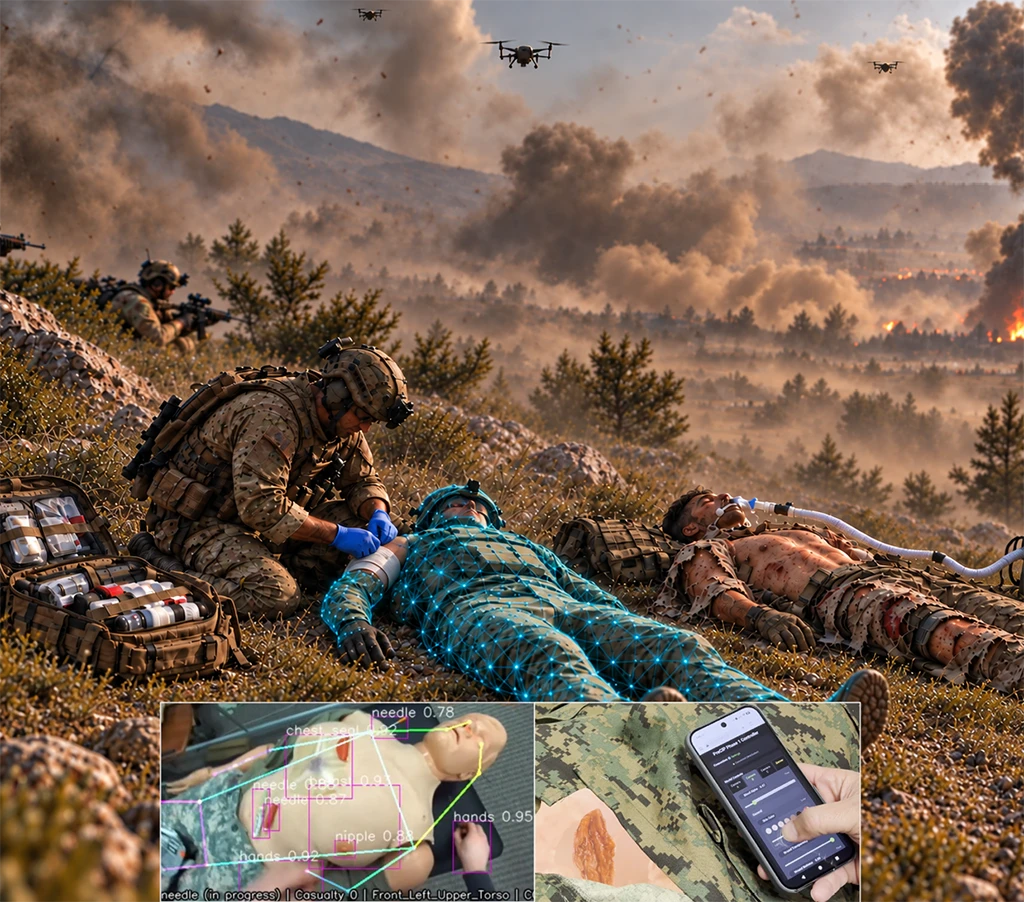
On the battlefield, medics must treat casualties while documenting each patient’s injuries and care. Kitware is developing Real-Time Automated Patient Identification and Documentation – Tactical Combat Casualty Care (RAPID-TC3) to help reduce this burden through automated reporting.
RAPID-TC3 combines a headset-mounted camera, stereo imaging, and edge AI to identify and track casualties during care. The system also recognizes medical equipment and procedures and generates 3D representations of patients. By associating medical interventions with individual casualties, the system generates Tactical Combat Casualty Care (TCCC) report data.
Designed for challenging battlefield conditions, RAPID-TC3 operates entirely on the edge and can run for two hours, helping medics focus on patient care.
Realistic Trauma Simulation with Pulse
Kitware’s Pulse Physiology Engine provides validated physiological and injury modeling to support realistic trauma simulation without relying on animal or human testing. Researchers can explore how the body responds to injuries and treatment, supporting medical training, battlefield readiness, and medical device development.
DEMO: Flexible-Screen Wound Simulation
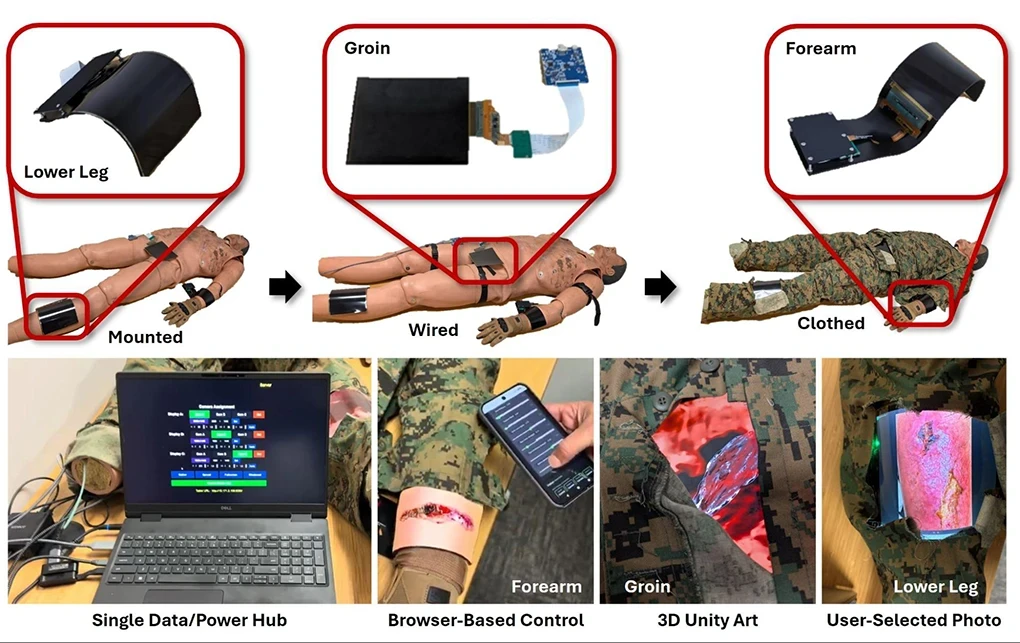
Kitware will demonstrate our digital moulage wound simulation tool, which uses flexible wearable displays to present realistic injuries on a manikin or live actor.
The technology creates an interactive training environment where students can examine wounds as they change over time. They can reveal underlying anatomy and vasculature, adjust wound characteristics, and display real wound photographs or custom imagery. The system can also present multiple synchronized injuries across the patient to support wound assessment and care training.
Computational Physiology for Digital Twin Development
The Pulse engine has been used to investigate patient outcomes in silico at both the individual and population levels and to inform medical decision-making. Researchers have also coupled Pulse with higher-fidelity models to address specific disease and treatment cases. Recent work has focused on creating synthetic data to train and test AI models, including large language models (LLMs) for medical decision-making. Pulse also serves as a virtual testbed for testing and informing critical care protocols, including hemorrhage resuscitation, ECMO, and ventilator management.
DEMO: Pulse Explorer
The Pulse Physiology Engine has an open-source user interface, the Pulse Explorer. The Pulse Explorer can be used to experiment with the Pulse engine capabilities. Users have the ability to load and customize a patient, apply injuries and treatments, create repeatable scenarios, and explore physiological variables and outcomes of the patient. The Pulse Explorer includes a mechanical ventilator for exploration of individualized responses to positive-pressure ventilation applied to treat injury and illness, including patients with and without spontaneous respiration.
Testbed for Autonomous Interventions and Robotics (TAIR)
Kitware is leading the development of an open-source virtual testing platform for robotic stroke interventions through ARPA-H’s Testbed for Autonomous Interventions and Robotics (TAIR) project. The platform combines Kitware’s Pulse Physiology Engine with open-source extended position-based dynamics to create realistic simulations of robotic interventions, enabling researchers to evaluate medical devices before clinical studies and reducing the reliance on animal testing.
Advance Medical Research with Kitware
Kitware combines research expertise and open source technologies to address complex challenges in military and medical research. From early-stage development to realistic simulation and evaluation, our team can help advance your next project.
Connect with Kitware to explore opportunities for collaboration.