AMIA 2026 Annual Symposium
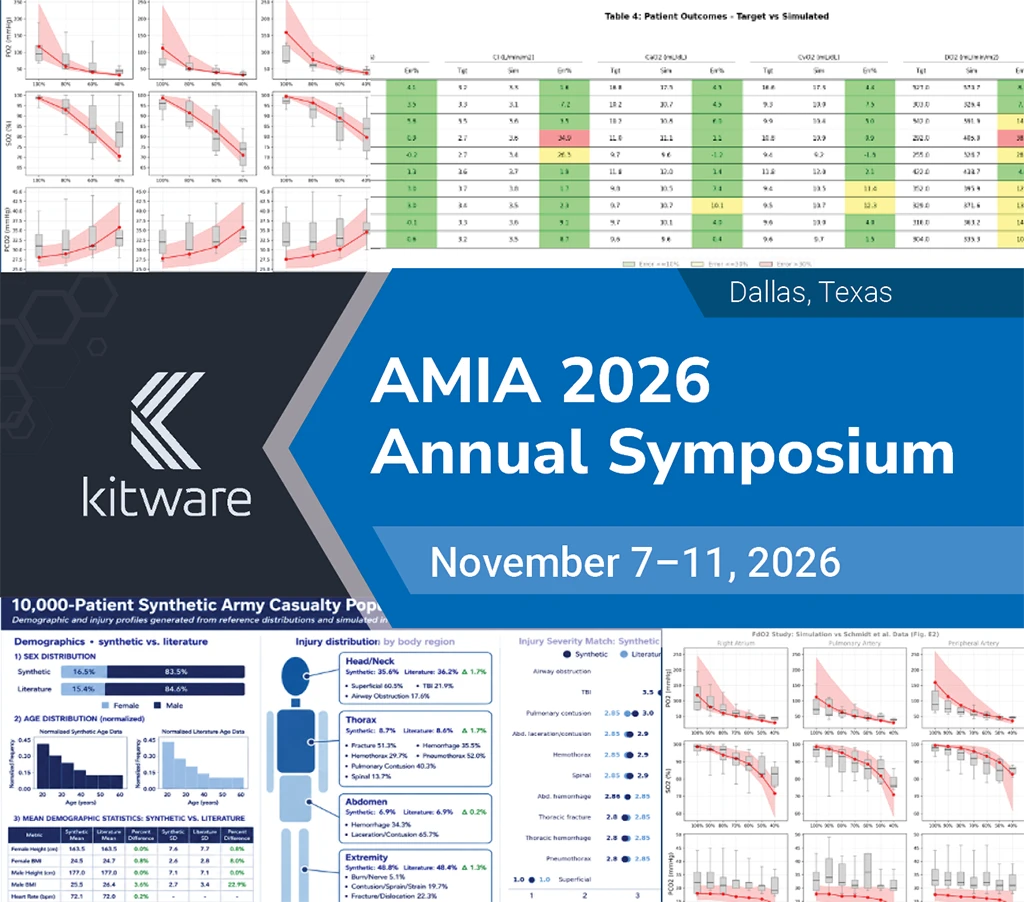
November 7–11, 2026 | Dallas, TX
Kitware is excited to participate in the American Medical Informatics Association (AMIA) 2026 Annual Symposium in Dallas, Texas. AMIA brings together professionals and students across the informatics community to share knowledge, foster collaboration, and advance the use of informatics to improve health and healthcare.
Kitware’s Rachel Clipp, Ph.D., will contribute to a workshop exploring the applications and challenges of biomedical, biological, and behavioral digital twins. Her invited presentation will include an interactive demonstration, and she will join fellow researchers and practitioners for a panel discussion on advancing biomedical digital twins.
Featured Presentation
Computational Physiology and the Potential for Digital Twins
Presenter: Rachel Clipp, Ph.D.
Session: W16: Biomedical, Biological, and Behavioral Digital Twins: Foundations, Applications, and Future Directions (Workshop)
Location: Cortez A, Hilton Anatole
Workshop Time: Saturday, November 7, 1:00-4:30 PM CT
Presentation Time: Saturday, November 7, 1:23–1:43 PM CT
Computational Physiology for Digital Twin Development
The Pulse Physiology Engine is an open-source computational physiology engine originally developed to provide accurate and consistent patient physiological data for medical simulation and training products, increasing realism and improving consistency across instructors and institutions. The engine incorporates existing and novel models of organs and physiological systems into a whole-body model.
Pulse has been further developed to implement and integrate multiscale models for an individualized, predictive model of whole-body patient physiology. Originally representing a single generic individual within a reference population, Pulse now incorporates patient-specific parameters that support digital twin development. These parameters modify baseline model parameters to achieve physiological responses and a homeostatic state representative of the specified patient.
The Pulse engine has been used in silico investigations to investigate health outcomes for individual patients or groups of patients and to inform medical decision-making. Researchers have also coupled Pulse with higher-fidelity models to address specific disease and treatment cases. Recent work has focused on creating synthetic data to train and test AI models, including large language models (LLMs). Pulse also serves as a virtual testbed for testing and informing critical care protocols, including hemorrhage resuscitation, ECMO, and ventilator management.
Demo
The Pulse Physiology Engine has an open-source user interface, the Pulse Explorer. The Pulse Explorer can be used to experiment with the Pulse engine capabilities. Rachel will demonstrate the ability to load and customize a patient, apply injuries and treatments, create repeatable scenarios, and explore physiological variables and outcomes of the patient. At the conclusion of the Pulse talk and demo, users will be able to explain the capabilities of the Pulse Engine and use the Explorer to create their own patients and cases to begin experimenting with computational physiology.
Biography
Rachel Clipp, Ph.D., is a Medical Computing Expert on Kitware’s Medical Computing Team located in Carrboro, North Carolina. Rachel leads medical modeling and simulation projects at Kitware, including those that involve the open-source Pulse Physiology Engine. Her recent focus has been on the use of Pulse as a digital twin for predicting patient outcomes and training and developing AI for medical decision-making. She also has experience with computational modeling projects using Lattice Boltzmann Methods, the development of dynamic boundary conditions for use in finite element analysis and computational fluid dynamics, and artificial intelligence models that represent outcomes from high-fidelity physics-based models and to predict life-saving interventions. She has a strong track record of securing funding from the NIH, ARPA-H, DARPA, DoD, and industry partners. Rachel received her Ph.D. and master’s degree in biomedical engineering from the University of North Carolina at Chapel Hill and North Carolina State University. She received her bachelor’s degree in mechanical engineering from Clemson University.
Contact