Kitware and UNC-Chapel Hill Release New Imaging Dataset Through ARPA-H AIR Program
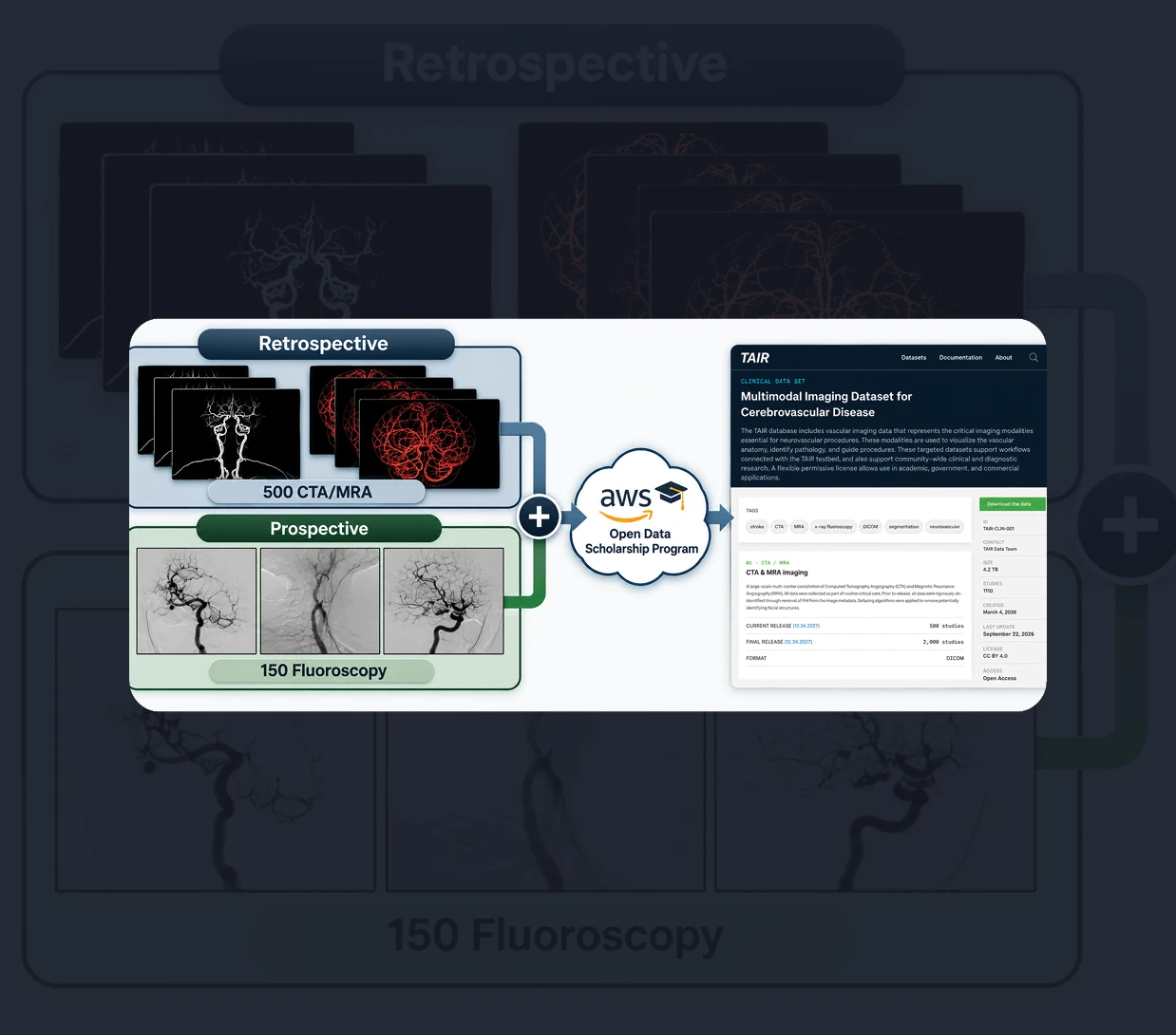
Kitware and the University of North Carolina at Chapel Hill are releasing the first installment of the Multimodal Imaging Dataset for Cerebrovascular Disease through the Testbed for Autonomous Interventions and Robotics (TAIR) project. Developed as part of the Advanced Research Projects Agency for Health (ARPA-H) Autonomous Interventions and Robotics (AIR) program, this first-of-its-kind dataset combines video fluoroscopy recordings with corresponding CT/MR angiography data to support research in autonomous robotics and cerebrovascular disease.
The first release includes 500 CT/MR angiography datasets and 150 video fluoroscopy recordings, with corresponding DSA and CT/MR angiography where available.
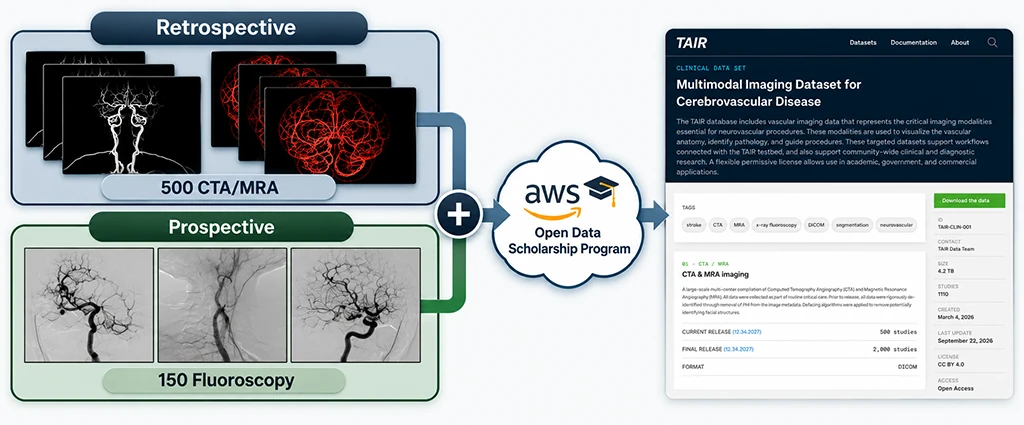
The data will be accessible through the TAIR clinical data website under the Creative Commons Attribution 4.0 International (CC BY 4.0) License, allowing academic, government, and commercial research and development. Users will be required to cite the dataset by providing a link to the data and referencing the associated publication.
Supporting the ARPA-H AIR Program
TAIR is a Kitware-led project developing an open-source virtual testing platform for robotic stroke interventions. The platform enables researchers to simulate stroke procedures and evaluate robotic medical devices across different anatomies and interventions before clinical studies.
As part of TAIR, Kitware and its clinical collaborators are collecting and curating medical imaging data that will be made available to the broader research community.
This dataset will support the AIR program for evaluation of autonomous robotic systems. It can be further used to train machine learning models for navigation and anatomic segmentation, support reinforcement learning, and serve as geometry for medical simulations. The data will also be segmented to create geometries for virtual simulations and predictive computational models. In the future, the data could also support machine learning models for identifying cerebrovascular disease and automating labeling.
The full collection is planned to include 2,500 CTA/MRA datasets and 1,500 video fluoroscopy recordings paired with corresponding CTA/MRA data, as available. The project also plans to release annotations for 150 recordings and images, along with 100 anatomic segmentations.
The project was accepted into the AWS Open Data Scholarship program, which will help support the long-term availability and maintenance of the Multimodal Imaging Dataset for Cerebrovascular Disease.
Additional Data Releases Planned Through 2027
The initial release is the first of four planned data releases. UNC and additional clinical sites are collecting data for future releases scheduled for March, June, and December 2027. The team also plans to release annotated datasets and vascular segmentations in December 2026.
Researchers and organizations interested in using the data can learn more about the project and access the available datasets through the TAIR project website.
This research was funded, in part, by the Advanced Research Projects Agency for Health (ARPA-H). The views and conclusions contained in this document are those of the authors and should not be interpreted as representing the official policies, either expressed or implied, of the U.S. Government.