Kitware Awarded up to $17.5 Million ARPA-H Contract to Develop Virtual Testing Platform for Robot-Assisted Stroke Interventions

3.5-year TAIR project will create a realistic, patient-specific virtual environment to accelerate the development and evaluation of robotic stroke devices.
Clifton Park, NY — August 6, 2026 — Kitware has been awarded up to $17.5 million by the Advanced Research Projects Agency for Health (ARPA-H), an agency within the U.S. Department of Health and Human Services, to lead the development of an open source virtual testing platform for robotic stroke interventions. The four-year Testbed for Autonomous Interventions and Robotics (TAIR) project will create a realistic environment that enables researchers to simulate stroke procedures and evaluate robotic medical devices for a range of anatomies and interventions before clinical studies.
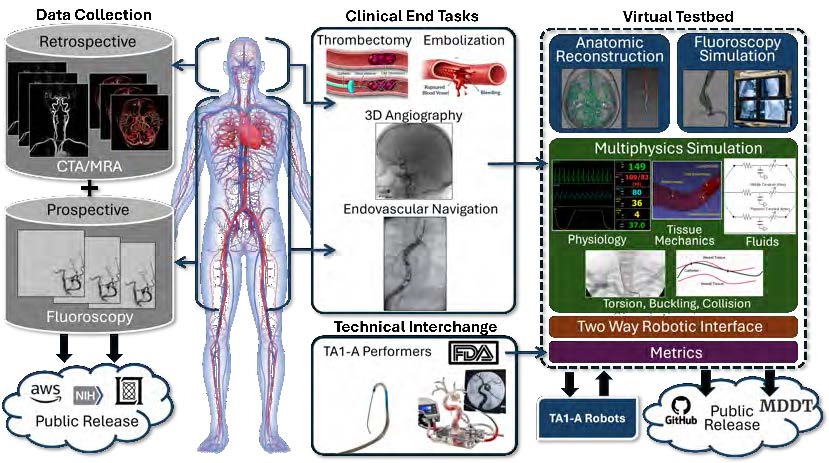
TAIR is part of ARPA-H’s Autonomous Interventions and Robotics (AIR) program led by ARPA-H Program Manager Ileana Hancu, Ph.D. The project is led by Principal Investigator Rachel Clipp, Ph.D., and Program Manager Jeff Webb and brings together researchers from Kitware, Johns Hopkins University, the University of North Carolina, the University of Pittsburgh, Florida State University, and Lightside Surgical, Inc. Kitware and the clinical team will collect and curate a large-scale medical imaging dataset that will be provided as open access. This dataset will include CT/MR Angiography and video fluoroscopy data, which will be available to the broader research community. UNC will serve as the clinical lead for the project; in addition to providing medical imaging data, they will annotate the data and contribute neurovascular interventional expertise as to the realism of the simulations.
The open source TAIR platform will use research-backed segmentation and shape analysis algorithms to generate anatomical reconstructions combined with multiphysics models to simulate robotic interventions. Kitware’s open source Pulse Physiology Engine and open source extended position-based dynamics will be used to model blood flow, patient physiology, vessel mechanics, and medical device to tissue interactions in real time. The open source DeepDRR tool from Johns Hopkins University will be extended and improved to address the realism and speed of virtual fluoroscopy simulations. TAIR will also provide an open interface for robotic systems to integrate with the simulator and quantitatively evaluate their performance through FDA defined metrics.
“By providing an open interface, we can enable robotic systems to communicate with the TAIR platform for navigation and performance evaluation using FDA-defined metrics, while supporting human-in-the-loop testing throughout the development process.” -Rachel Clipp
TAIR reflects Kitware’s long-standing commitment to open science. All software developed through the project will be released as open source, and the medical imaging data will be made available through open-access repositories. The team also plans to submit TAIR to the FDA’s Medical Device Development Tools (MDDT) Program, creating a foundation that will support future robotic and image-guided interventions beyond stroke care.
For more information about Kitware and its medical software research, contact our team.
Acknowledgment and disclaimer: “This research is funded, in part, by the Advanced Research Projects Agency for Health (ARPA-H). The views and conclusions contained in this document are those of the authors and should not be interpreted as representing the official policies, either expressed or implied, of the U.S. Government.”
About Kitware
Kitware delivers innovation to its customers. As a software research and development company, Kitware solves the world’s most complex scientific challenges using custom software solutions built on open source technology. In addition to custom software development, the company also offers technical support and training services to anyone using its open source tools. Since its founding in 1998, Kitware has developed a reputation for its unparalleled technical expertise and excellent customer service. The company is proud to be 100% employee-owned. For additional information, visit kitware.com or follow them on LinkedIn and Twitter.