WACV 2026
March 6 – 10, 2026 | Tucson, Arizona
The IEEE/CVF Winter Conference on Applications of Computer Vision will be held March 6 – 10 in Tucson, Arizona, bringing together the global computer vision community for several days of technical exchange and collaboration. The conference features peer-reviewed research, hands-on tutorials, and focused workshops covering the latest advances in AI and computer vision. We invite attendees to visit Kitware to see how our work is translating research into real-world impact.
Kitware maintains a long-standing and active presence in WACV, including exhibiting, organizing, contributing research, and serving on program committees. This year is no different, with several of our team members taking on key roles:
- Anthony Hoogs, Ph.D. is on the advisory committee for the Workshop on Real-World Surveillance: Applications and Challenges.
- Scott McCloskey, Ph.D., Christopher Funk, Ph.D., and Matt Leotta, Ph.D. are serving as area chairs.
- Scott McCloskey, Ph.D. is serving as a Workshop chair.
- Christopher Funk, Ph.D. and Florence Yellin, Ph.D. are serving as Workshop Organizers for the Foundational Models Beyond the Visual Spectrum – FoMoV
Stop by to learn how Kitware’s open source platforms and custom-developed solutions are helping define what’s next for the field.
Kitware’s Contribution
ScatSpotter: A Dog Poop Detection Dataset
Accepted Paper
Author: Jonathan Crall
This paper will be presented at WASTEVISION: International Workshop on Smart Waste Monitoring on Friday, March 6, at 8:30 AM in the AZ Ballroom Salon 3-4.
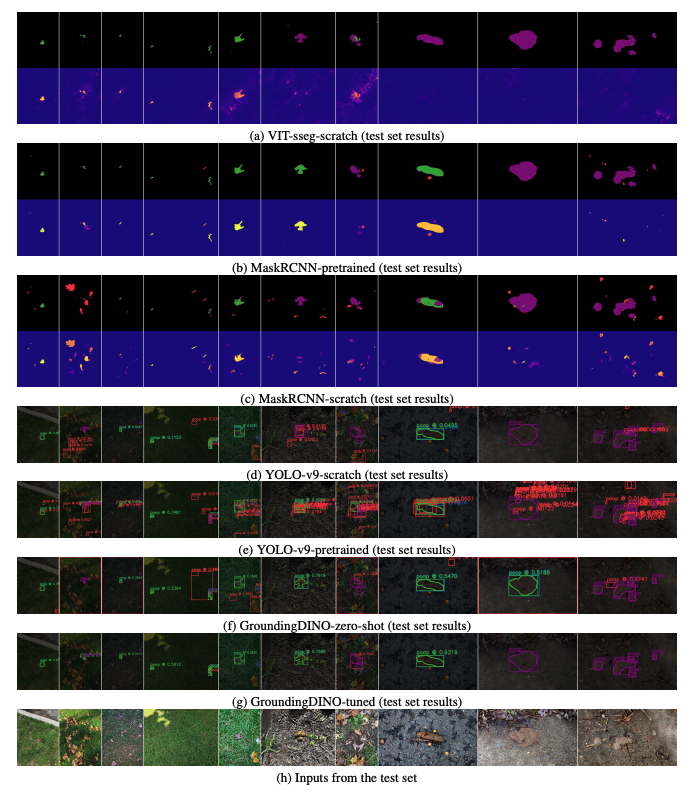
Detecting small, irregular waste objects in outdoor environments remains a challenging problem for computer vision due to their low contrast, amorphous shape, and frequent camouflage within natural clutter such as leaves, dirt, and debris. These objects are underrepresented in existing large-scale vision datasets, limiting model performance in applications related to environmental cleanliness, public health, and autonomous cleanup. In this paper, we introduce ScatSpotter, a large, high-resolution dataset of smartphone images annotated with polygon segmentations of dog feces, designed as a prototypical benchmark for small, camouflaged waste detection. The dataset contains over 9,000 full-resolution images and 6,000 polygon annotations, collected primarily in urban outdoor settings using a novel before/after/negative (BAN) capture protocol that provides counterfactual negatives and visually similar distractors. We provide standardized training, validation, and independently sourced test splits, and evaluate a range of modern detection and segmentation models, including Mask R-CNN, YOLO-v9, Vision Transformers, and Grounding DINO. Our results show that zero-shot foundational models perform poorly on this task, while fine-tuned models achieve strong but imperfect performance, highlighting the remaining difficulty of detecting small, camouflaged waste objects. In addition, we study centralized and decentralized dataset distribution mechanisms, comparing transfer speed, robustness, and cost. ScatSpotter is released under a permissive CC-BY 4.0 license with accompanying code and baselines, supporting future research in small-object detection, waste monitoring, and environmentally focused computer vision applications.
Featured in the WACV Daily Newsletter
Jon Crall was featured in the WACV Daily Newsletter, a daily publication produced by Computer Vision News and distributed to conference attendees throughout WACV. The newsletter is published by independent computer vision journalist Ralph Ansarouth, who has covered major CV conferences for more than a decade.
In the interview, Jon discussed his work at Kitware and the research behind ScatSpotter, his dataset focused on detecting small, camouflaged waste objects in outdoor environments.
“This may sound silly—and it is—but it’s also a serious and challenging vision problem with practical applications,” said Jon.
The interview highlights Jon’s return to WACV after more than a decade, having previously presented HotSpotter in 2013 and now presenting ScatSpotter, which explores real-world computer vision challenges with practical applications in environmental monitoring and autonomous cleanup.
Kitware is hiring!
At Kitware, we’re not just advancing technology; we’re building a team of passionate innovators ready to make a difference. If you’re interested in joining a company where collaboration and innovation thrive, stop by our booth to learn more about our career opportunities.
We pride ourselves on fostering an environment where our team members feel empowered to grow, learn, and make meaningful contributions to cutting-edge projects. Whether you’re just starting your career or looking for your next big challenge, Kitware offers opportunities to work on impactful solutions that shape the future.
Computer Vision Researcher: Conduct research and develop robust solutions in the areas of vision-language models, object detection, activity detection, tracking, anomaly detection, open-world learning, multimedia forensics, explainable/ethical AI, and more.
Natural Language Processing Researcher: Develop robust solutions in the areas of natural language processing, large language models (LLMs), foundation models, ML, and AI. Conduct research on content understanding, knowledge extraction, reasoning, decision-making, disinformation mitigation, and more. Opportunity to engage with the research community and to pursue new research directions.
3D Computer Vision Researcher: Conduct research and develop solutions for problems related to camera calibration, registration, structure from motion, neural rendering, neural implicit surfaces, surface meshing, and more.
Technical Leader of Natural Language Processing: Lead research and development with an emphasis on natural language processing, generative models, and AI. Pursue related research areas of growth with support and mentorship from the company leadership.
Machine Learning Engineer: Collaborate with researchers on a variety of exciting projects to design, implement, train, and test ML and AI systems to solve real-world problems.
CareersDriving Innovation Through Research and Collaboration
Kitware maintains a strong, ongoing commitment to exploring new research directions and advancing development efforts across a wide range of technical domains. Our adaptable technologies are designed to operate in diverse environments, allowing us to address complex challenges wherever our customers need solutions.
We apply our expertise in computer vision and deep learning to support a broad community, including academic researchers, commercial organizations, and defense and intelligence stakeholders. Our collaborations span numerous U.S. government organizations, including but not limited to DARPA, AFRL, ONR, NGA, the U.S. Army, and the U.S. Air Force, as well as leading universities through federally funded research programs.
With deep experience in software research and development, Kitware partners with organizations to tackle demanding computer vision problems. Contact us to learn how we can work together to develop solutions tailored to your mission.