M&M 2026
August 2-6, 2026 | Booth #1222 | Milwaukee, Wisconsin
Kitware is pleased to be returning to the Microscopy & Microanalysis (M&M) conference. This year, we will be exhibiting and hosting a vendor tutorial about the Tomviz 3.0 release. We also had a platform presentation accepted on our DOE Phase II-funded open source multivariate visualization work. Visit us at Booth #1222 to learn more, or contact our team to schedule a meeting.
Free Webinar: Tomviz 3.0: A Reimagined Open Source Pipeline for Tomographic Data Analysis
September 16, 2026 | 12-1pm ET
Conference Schedule
Tomviz 3.0: A Reimagined Open Source Pipeline for Tomographic Data Analysis
Presenter: Patrick Avery
Vendor Tutorial | Monday, August 3, 2026 | 5:45 PM – 6:45 PM CT | Location: Booth #1222
Tomviz is Kitware’s open source application for 3D tomographic microscopy reconstruction, visualization, and analysis. With Tomviz 3.0, we have added improvements such as a redesigned node-based pipeline with support for reproducible workflows, branching analysis paths, and AI-assisted reconstruction and segmentation through external operators. Join us at Booth #1222 on Monday evening for the tutorial and stay to ask questions.
Explore Tomviz 3.0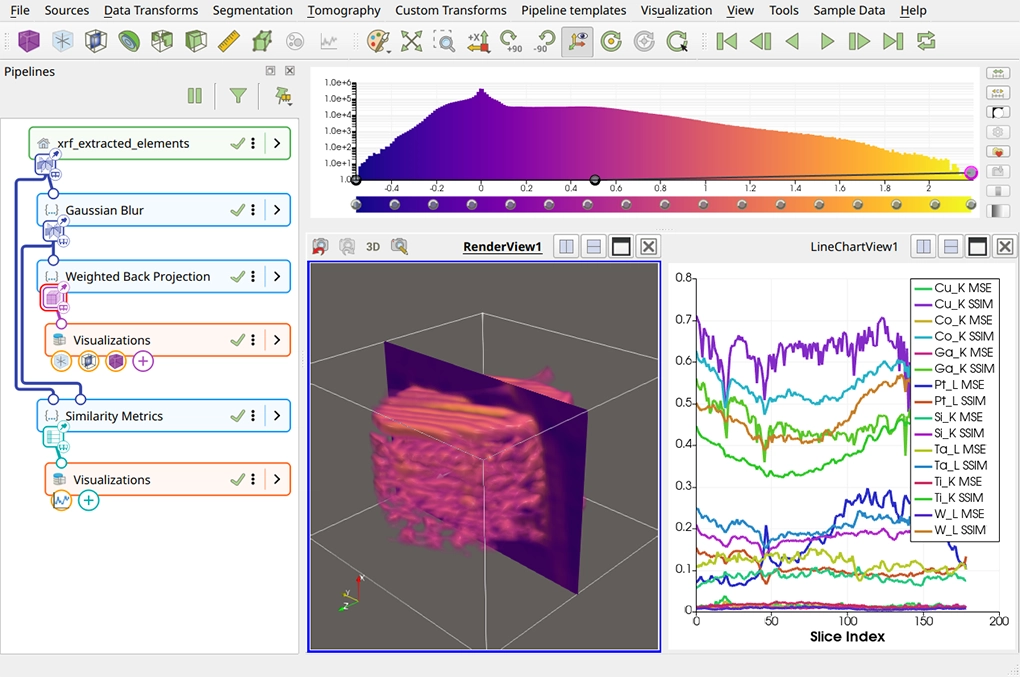
Multivariate Volume Rendering in VTK, ParaView, and Tomviz: Desktop and Web Implementations
Session: C08.1 Vendor Symposia
Presenter: Patrick Avery
Platform Presentation | Tuesday, August 4, 2026 | 8:30 AM – 8:45 AM CT | Location: S103 A (Subject to change)
Building on the multivariate visualization work we presented at M&M 2024 and 2025, this talk shows those prototype capabilities graduating into production tools. Multivariate volume rendering is being integrated directly into VTK and ParaView, a first for both libraries, with radial colormaps that display multiple elemental channels simultaneously to reveal cross-channel correlations. We will also preview the new web-based Tomviz, built on the trame framework, which brings interactive volume rendering and full pipeline editing to any standard web browser, with a public release planned for later this year. This work is a collaboration with Stony Brook University and Brookhaven National Laboratory, funded by a DOE SBIR award.
Supporting the Growing Demands of Microscopy Data and Analysis
High-Performance Visualization for Large Microscopy Datasets
Advances in microscopy continue to increase both the size and complexity of imaging data, creating challenges for visualization, exploration, and analysis. From volumetric tomography datasets to large-scale time-series and multimodal imaging studies, researchers often need to work with data that exceeds the capabilities of traditional desktop workflows. Kitware develops GPU-accelerated visualization systems that support interactive exploration of large 2D, 3D, and 4D datasets, enabling researchers and software teams to efficiently inspect, analyze, and communicate results across a range of microscopy applications.
Scalable Processing and Analysis Workflows
As datasets grow, the computational demands of reconstruction, segmentation, feature extraction, and quantitative analysis increase too. Kitware develops software infrastructure that enables microscopy workflows to leverage modern computing environments, including multi-core systems, HPC resources, and distributed computing architectures.
Our work focuses on creating efficient, reproducible workflows that help researchers process larger datasets, reduce turnaround times, and integrate advanced analysis methods into existing scientific workflows without disrupting established research practices.
Sustainable Tools
Software architectures must remain extensible, maintainable, and adaptable to new requirements. Kitware specializes in building open, modular software systems that support visualization, analysis, and data management while avoiding the limitations of tightly coupled or proprietary solutions. By combining custom R&D with proven open source technologies, we help organizations develop software platforms that accommodate future imaging modalities, computational methods, and deployment environments without starting from scratch.

Tomviz provides a complete solution for materials, from raw projection images to reconstructed electron tomography data, using a state-of-the-art graphical interface. It’s capable of rendering data as shaded contours or volumetric projections, as well as slices, measurements, and other representations.

trame provides a simple, easy-to-use framework for creating visual analytics applications for Web, desktop, and Jupyter. With best-in-class VTK and ParaView platforms at its core, trame provides complete control of 3D visualizations and data processing.
Advanced Volumetric Rendering
Large volumetric microscopy datasets require visualization techniques that balance image quality and performance. Our work on Volumetric Rendering in VTK and ParaView: Introducing the Scattering Model on GPU introduces advanced GPU-based rendering methods that help researchers better visualize and interpret complex volumetric data.
Bivariate Representations in ParaView
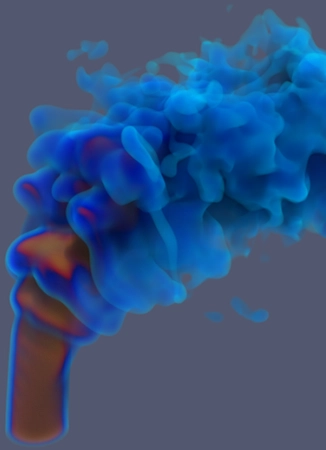
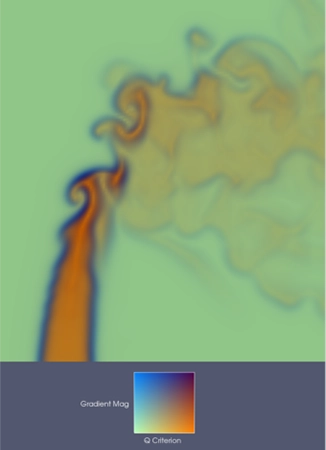
Simulation and imaging datasets often contain multiple scalar fields that are valuable to analyze together. Recent work in ParaView introduces new bivariate visualization tools that help researchers explore relationships between two variables simultaneously. These capabilities include volume bivariate rendering and new surface representations, providing additional ways to investigate complex datasets within a single visualization.
Desktop Holograms for Materials Science
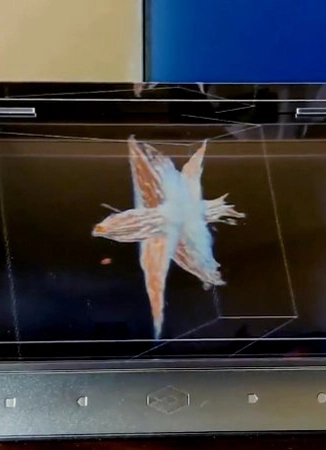
Tomviz supports interactive visualization of electron tomography data on Looking Glass holographic displays, allowing multiple researchers to view and explore true 3D microscopy datasets simultaneously without the need for headsets. By combining Tomviz with holographic displays, researchers can manipulate and examine volumetric data in real time, supporting collaborative scientific analysis.
Using ITK in Tomviz
Tomviz integrates the Insight Segmentation and Registration Toolkit (ITK) through Python, giving researchers access to ITK image processing algorithms directly within the Tomviz application. This integration enables image processing capabilities to be incorporated into tomography analysis workflows while providing a framework for developing and extending custom data operators.

Atomic Structures in Tomviz
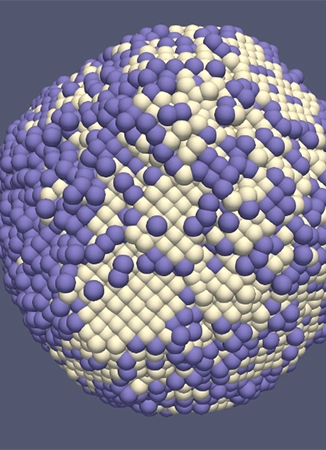
Tomviz supports atom probe tomography and atomic electron tomography by enabling researchers to work directly with atomic structures extracted from their datasets. Atomic data can be loaded from files or generated through tomography analysis pipelines, allowing reconstructed volumes and atomic structures to be visualized within the same application.
Scientific Visualization at Kitware
Kitware develops custom software to help solve high-performance computing and visualization challenges. Our capabilities include:
- AI/ML integration
- Cross-platform interactive applications
- End-to-end simulation workflows
- High-performance scientific visualization
- Microscopy visualization
- Multi-modal imaging
- In-situ computing
- Tomography
- Web-based visualization
Kitware delivers cross-platform, interactive visualization applications to our customers and collaborators. Built on our open source platforms, our solutions are cost-effective, easy to use, and fully customizable.
We have decades of experience working with government labs, research centers, universities, and commercial organizations. We specialize in delivering tailored software solutions that help you achieve your goals. We aim to deliver innovative solutions that not only meet your requirements but also integrate with your existing tools and workflows.
Visit Booth #1222 during M&M 2026 to speak with our team.
Can’t attend the conference? Contact our team