Pulse v4.4.0 Release
Thank you for being a valued member of the Pulse community! We’re pleased to share our latest release, an upcoming webinar, and a peek at what’s ahead.
Pulse v4.4.0 is here!
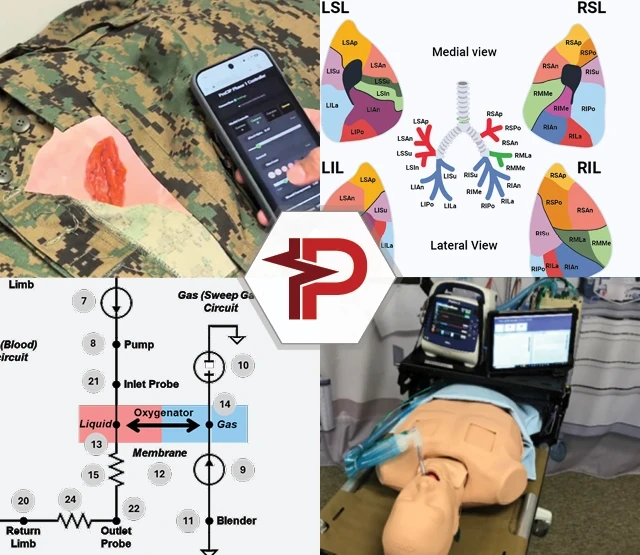
This release includes improvements to hemorrhage modeling, the option to enable a more detailed cardiopulmonary model that resolves individual bronchopulmonary segments, a new extracorporeal membrane oxygenation (ECMO) model, and updates to the drug model.
This release also introduces workflows and pipelines to support multiphysics integration, population generation, digital twin investigations, and closed-loop algorithm development and testing.
Explore the updates in the release notes.
What’s New in the Pulse Physiology Engine 4.4.0 Webinar
Wednesday, September 30, 2026 | Noon–1 p.m. ET
Join Jeff Webb and Aaron Bray for a free webinar exploring the latest Pulse capabilities. We’ll demonstrate new features, highlight recent projects, and discuss applications in digital twins, clinical decision support, autonomous medicine, and hardware-in-the-loop testing. A live Q&A will follow.
Register for the webinar. The webinar will be recorded and available to watch afterward.
MHSRS 2026 Highlights
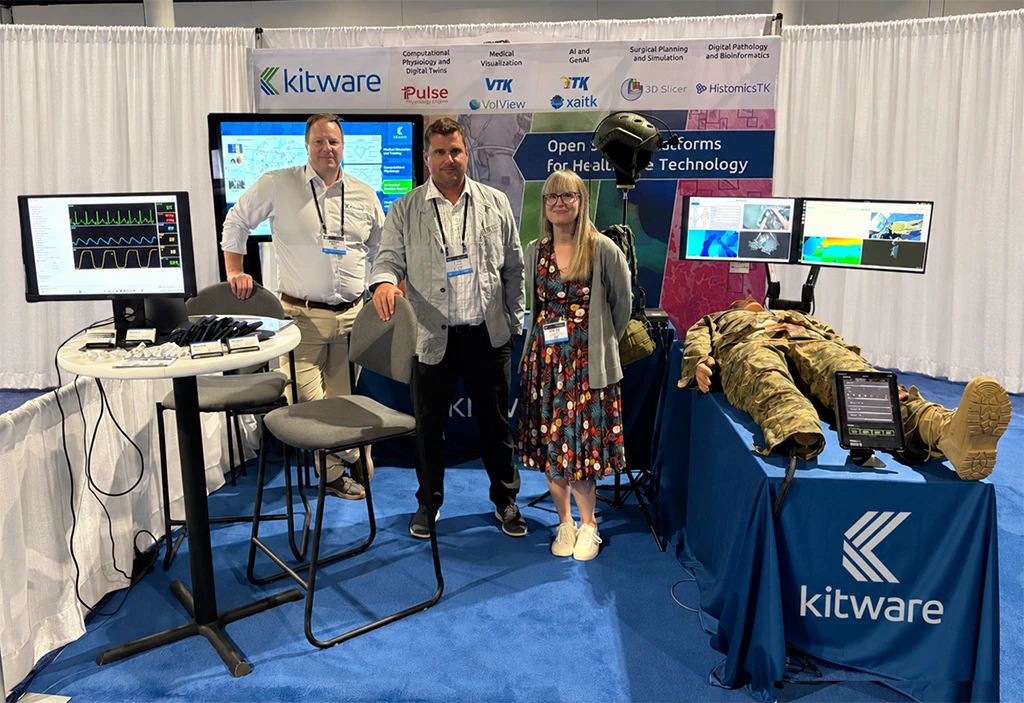
We enjoyed connecting with the medical research community at the 2026 Military Health System Research Symposium (MHSRS). At our booth, we demonstrated our digital moulage prototype, new medical device models, digital twin generation, and other Pulse capabilities.
Thank you to everyone who stopped by to share your work, ask questions, and explore collaboration opportunities. These conversations help shape the future of Pulse and connect us with new applications for physiological simulation.
Watch our blog for updates on upcoming events and opportunities to meet our team.
Where will we be next?
AMIA 2026 Annual Symposium | Dallas, Texas | November 7–11
Rachel Clipp, Ph.D. will co-present the workshop “Biomedical, Biological, and Behavioral Digital Twins: Foundations, Applications, and Future Directions” on November 8 from 1:00–4:30 p.m. She will discuss how Pulse fits into a digital twin framework and lead a hands-on demonstration using Pulse Explorer.
Attending AMIA? Reach out to connect with Rachel in Dallas!
Innovative Use Cases
The Pulse community continues to grow, with new applications spanning medical training, physiological research, and technology development. Explore how researchers and developers are using the engine on our Pulse in Action and Publications pages.
We’d love to hear how Pulse is helping you achieve your goals. Have a success story, publication, or interesting application to share? Complete our quick use case submission form for an opportunity to be featured on our website.
What’s Next?
We’re continuously working on new innovations to further enhance the Pulse Physiology Engine. Here are a few upcoming developments you can look forward to:
- Virtual testing for robotic stroke interventions: As part of ARPA-H’s Autonomous Interventions and Robotics (AIR) program, Pulse will contribute patient physiology and blood-flow modeling to the Testbed for Autonomous Interventions and Robotics (TAIR). This open-source platform will support developing and evaluating robotic stroke interventions in virtual patients. Read more about TAIR.
- Virtual populations for triage research: Through DARPA’s In the Moment (ITM) program, we’re continuing to expand virtual patient population generation capabilities to represent diverse patient characteristics, injuries, and treatment responses, supporting the development and evaluation of triage decision-support tools.
- Multiscale physiological modeling: We’re exploring tighter coupling between Pulse’s whole-body physiology and higher-fidelity models to connect detailed organ and tissue behavior with systemic responses.
- Exposure and treatment modeling: Planned enhancements include overdose modeling, drug bioavailability, and inhaled substance deposition to better represent how substances enter the body and influence physiology.

Get in Touch
Have a question or an idea for collaboration? Contact us.
For the latest news, subscribe to the blog and visit the Pulse website.