Conference on Applied Machine Learning in Information Security (CAMLIS) 2026

October 21-23, 2026 | Arlington, VA
Join Kitware at CAMLIS 2026, where our team will present research on aligning autonomous cyber defense agents with different security objectives. Learn more about our work in artificial intelligence, machine learning, and cybersecurity, and connect with our team to discuss technical challenges and opportunities for collaboration.
Presentation Schedule:
Alignment of Autonomous Cyber Defense Agents via Adaptive Policy Shaping
Authors: Dena Mujtaba, Barry Ravichandran, Brian Hu, and Arslan Basharat
Date: Oct 22, 2026
Description: Autonomous cyber defense agents are used to protect critical networks against various attacks, but aligning these agents with different operational priorities raises important questions about their effectiveness across networks and adversaries. This research examines how agents can be steered to prioritize confidentiality, integrity, and availability, three critical attributes of network resilience. The findings highlight an understudied tradeoff between alignment and performance and examine how alignment techniques scale across different network environments and adversaries.
Cybersecurity Expertise:
AI-Assisted Cybersecurity Decision-Making
Kitware applies its expertise in artificial intelligence and machine learning to research complex cybersecurity decision-making challenges. Through Phase 2 of DARPA’s In the Moment (ITM) program, Kitware is extending its work on human-aligned AI into cybersecurity, exploring how AI systems can account for competing priorities such as confidentiality, integrity, and availability. This work explores how AI systems can support cybersecurity decisions that require balancing competing operational priorities.
Autonomous Cyber Defense and Multi-Agent Systems
Kitware researches autonomous cyber defense agents that use reinforcement learning (RL) and large language models (LLMs) to protect networks against cyberattacks. This work includes developing agents in simulation and emulation environments, as well as exploring multi-agent systems that can align their behavior with different operational priorities and objectives. Kitware’s cybersecurity research also includes using LLMs for network log analysis and visualizing complex attack paths across networks.
Software Supply Chain Security
Kitware combines its software engineering and build system expertise with cybersecurity research to improve visibility into software components and dependencies. Through DARPA’s E-BOSS program, Kitware is working with Riverside Research to strengthen software supply-chain security. This includes experimental Software Bill of Materials (SBOM) generation capabilities in CMake, enabling software inventories to be produced using information available from the build system. These inventories provide structured information that can support downstream cybersecurity analysis, compliance, and software maintenance.
Detecting Social Engineering Threats
Kitware researches how artificial intelligence and natural language processing can help identify cybersecurity threats. Through DARPA’s Semantic Forensics (SemaFor) program, Kitware developed ConvoSentinel, a research pipeline for detecting chat-based social engineering attempts. The research explores how large language models can generate deceptive conversations and how automated analysis can help identify potentially malicious interactions, including attempts to obtain sensitive information.
Related Projects:
Evaluating AI Systems Against Adversarial Threats
AI-enabled military systems face security risks from digital, cyber, and physical-world attacks. Through DARPA’s SABER program, Kitware is helping address these challenges by developing techniques to identify vulnerabilities and evaluate how AI-enabled ground and air systems perform in contested environments.
Advancing Human-Aligned AI for Cybersecurity Decision-Making
Through DARPA’s In the Moment program, Kitware is developing AI systems that provide transparent recommendations aligned with human reasoning and priorities. Building on its work in military medical triage, Kitware is now applying these techniques to complex cybersecurity decisions.

Generating Software Bills of Materials with CMake
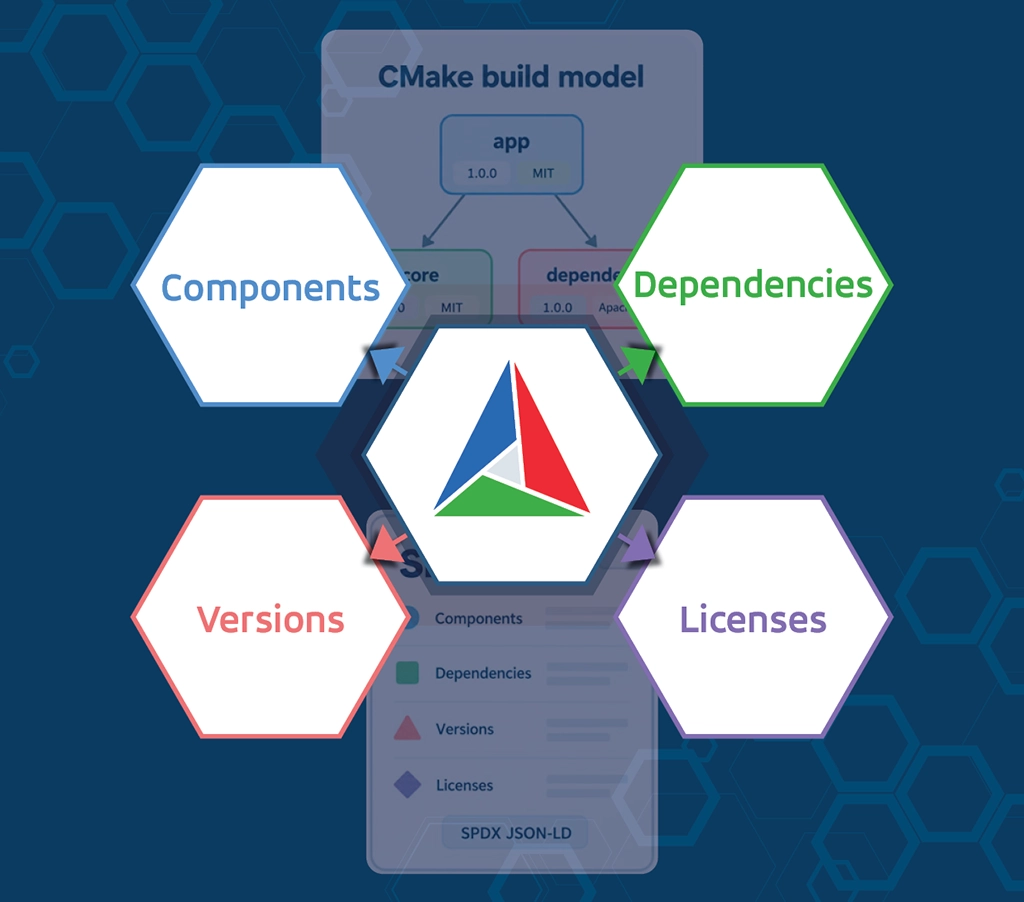
CMake now includes experimental support for generating Software Bills of Materials (SBOMs) directly from a project’s build description. This capability provides a standardized inventory of software components and dependencies to support cybersecurity analysis, license compliance, and auditing while reducing reliance on post-build scanning tools.
Strengthening Software Supply Chain Security with CMake
Software vulnerabilities can be difficult to address when systems depend on hundreds or thousands of third party components. Through our collaboration with Riverside Research, we have enhanced CMake to improve software management, helping organizations better track cybersecurity risks and securely deploy software patches.
Meet with the Experts
Interested in learning more about Kitware’s cybersecurity research and capabilities?
Connect with our team